
Latin America's most concentrated capital cities
Brazil, with 215M people, is Latin America's least capital-concentrated country, despite having 3M in Brasilia.

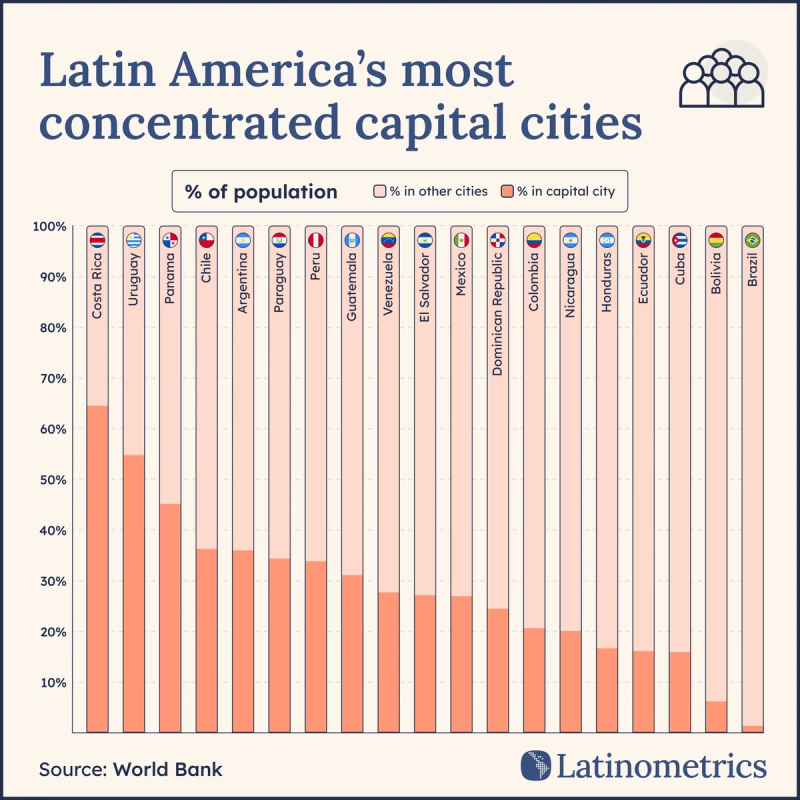
While Costa Rica centralizes in San Jose, Brazil disperses across dozens of cities.
Latin America has tons of beautiful cities renowned the world over. Buenos Aires with its architecture. Rio de Janeiro with its beachside mountains. Havana with its colonial city center.
One city you won’t often hear called beautiful? Brasilia, the modernist capital of Brazil, which was founded in 1960 and is known for its planned layout and sprawling highways.
Brasilia is actually Brazil’s third-most populous city, yet it contains less than 3M of the country’s 215M citizens. By this standard, Brazil is the least capital-concentrated country in all of Latin America, ahead even of Bolivia—which has two capitals!
On the flip side, a majority of Costa Ricans and Uruguayans live in their respective capitals, which might explain why most of you would struggle to name another city in those countries besides San Jose and Montevideo.
Given Uruguay barely has more inhabitants in total than Brasilia, you might just think it’s a question of size. But you’d be wrong: Argentina, for example, is the eighth-largest country worldwide yet has long had a dominant capital city holding nearly half the country’s population.
In fact, Argentina spent its first four decades as an independent country consumed by civil war over just how much power and autonomy Buenos Aires, as the main city and port of the country, should have. The debate ended in 1880 with the federalization of the city, meaning the Argentine capital no longer is part of any province (even the one carrying its name) and is instead directly administered by the national government.
Does spreading people across many cities make a country stronger or harder to hold together?


