
Deadliest Natural Disasters in Latin America: a Timeline
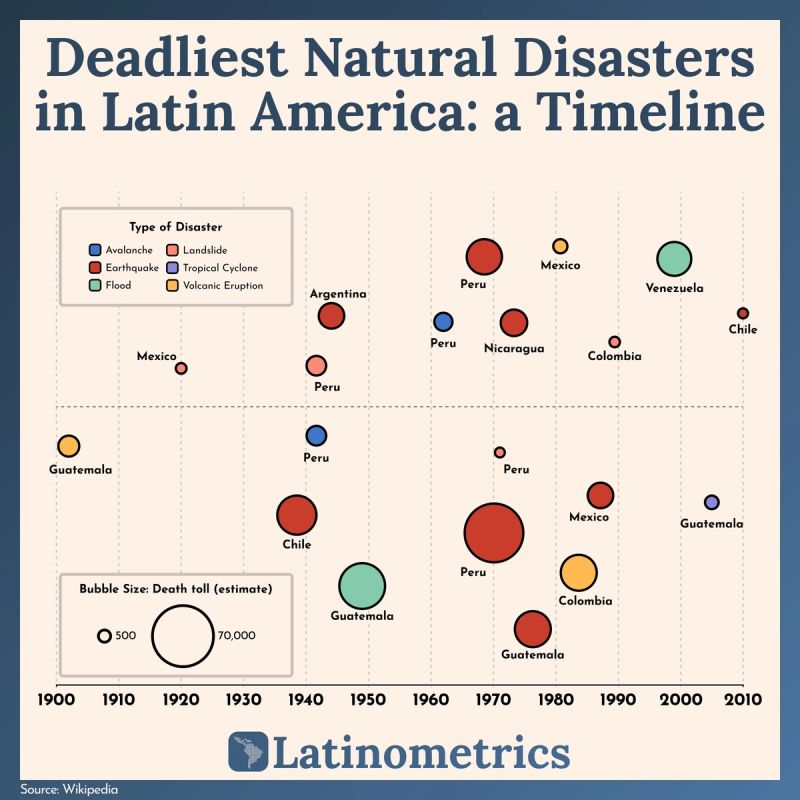
The 1985 Armero tragedy killed 2/3 of a town; government inaction often amplified LatAm's deadliest natural disasters.

Almost any country or region has been defined in the past by its brushes with nature, particularly those that did not end too well. There’s the 1755 earthquake which devastated Lisbon, or the way in which New Orleans has never fully recovered as a city from Hurricane Katrina.
Latin America is no exception.
The region has seen its fair share of natural disasters, often with drastic consequences for the locals. There’s the Armero tragedy of 1985, for example, in which a dormant stratovolcano’s eruption killed more than two-thirds of one small nearby town and led to widespread discontent with a government which failed to act decisively.
There’s also the Huascarán Debris Avalanche from 15 years earlier, the deadliest avalanche or glacier-related disaster in recorded history, in which an earthquake-caused mudflow destroyed a number of towns and villages, killing up to 30k people.
With each of these, government action (or inaction) was important, as was the prospect of a prepared population. The disasters left lasting impressions on the people and perhaps even shaped modern cultural identities to some degree.
For example, Hurricane Maria, which hit Puerto Rico and its neighbors in the northeastern Caribbean, was the costliest and deadliest hurricane to ever hit the US territory. Nearly $100B in damages were accrued, while over 3K people were killed.
Whether it be tropical cyclones hitting Acapulco or mudslides across the Andes, Latin Americans must clearly live with some degree of caution as they interact with their natural surroundings.


