
Declining Fertility: Half of LatAm Now Below Replacement Level
Half of LatAm is below replacement level, but Brazil, Mexico, Colombia, and Argentina are among them.


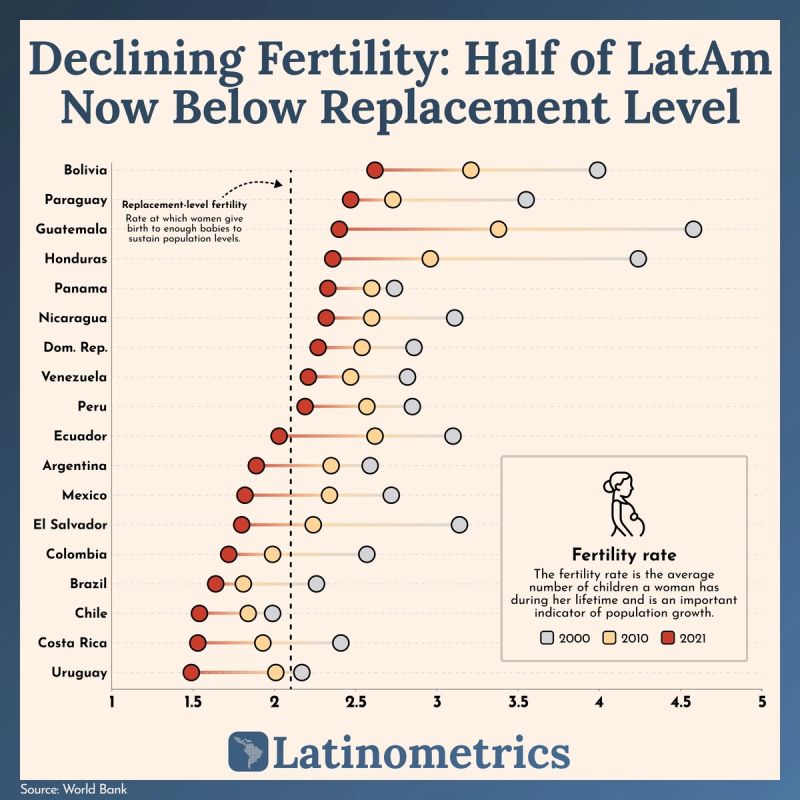
Peep the chart above—where does your country fall?
Last year, we wrote on declining birth rates in Latin America, and how the United Nations expected that by 2055 women in Europe would be giving birth to more babies on average than Latin American women. This week, we want to take a different approach, by focusing on specific countries and how their fertility rates give us a look into the future.
Fertility rate reflects the average number of a children a woman has in her lifetime. The replacement rate, meanwhile, is a fertility rate of just about 2.1, in which enough babies are being born to sustain current population levels within a given country.
As of the time of writing, roughly half of Latin America’s countries are still exceeding the replacement rate—critically, however, none of the four largest (Brazil, Mexico, Colombia, or Argentina) fall into this grouping.
Traditional logic expects that countries’ fertility rates will slow as they grow more developed due to a combination of better economic conditions and empowerment for women, lower infant mortality rates, and greater education and access to birth control.
Looking at the above chart, this seems to largely track, with the most-developed countries in the region – Chile, Uruguay, and Costa Rica – on one end while some of the least-developed – Guatemala, Honduras, and Nicaragua – fall on the other end. Some of the most religious countries in the region, such as Bolivia and Paraguay, are also seeing higher fertility rates than many of their neighbors.
Notably, there are some unexpected results, whether that be Panama falling above the replacement rate or El Salvador falling below it.
The important takeaway, however, is that it’s completely normal for Latin America to slow down in population growth in the coming decades, just as it’s been seen in Europe and many of the wealthiest Asian states like Japan or South Korea. What’s more important is that the region reaches sufficient economic development and equity by this point.


