
What's the growth outlook for Latin America this year?
Argentina's 5% growth leads LatAm, but Mexico faces contraction and Venezuela shrinks 4%.

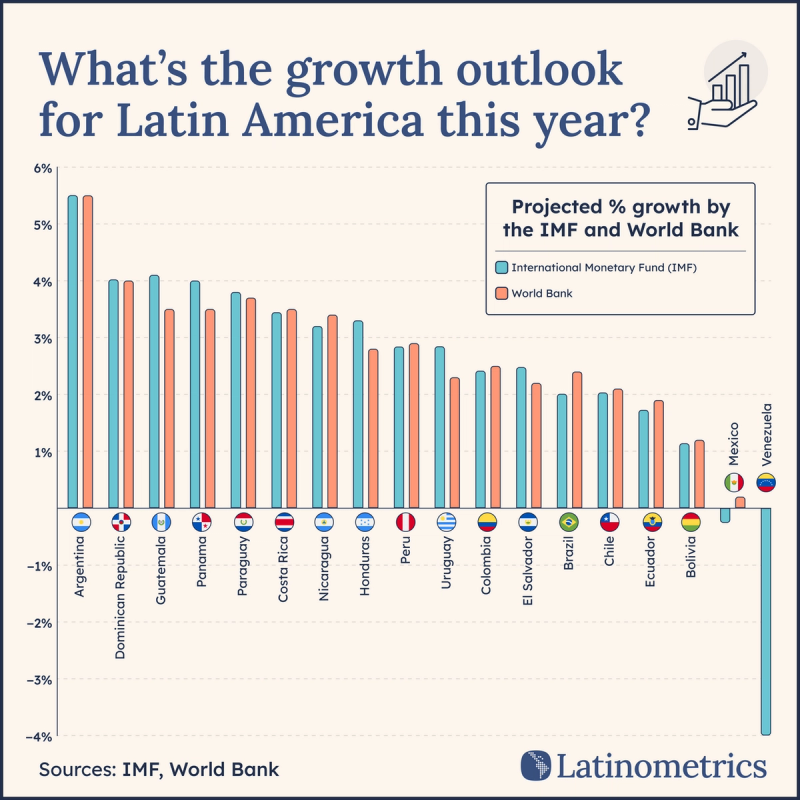
Two leading institutions give their takes on Latin America's growth for this year.
We're officially at the halfway point of 2025—so let's take stock of where economies are today. Which of the region's countries are allegedly growing this year…and which ones are not?
Looking at contemporary 2025 projections from the World Bank and the International Monetary Fund (IMF), Argentina is clearly this year's economic growth success story.
While struggles remain, with roughly a third of the population still in poverty, a 5% growth projection is certainly a welcomed development for a country that has struggled to stabilize in recent years. It's also worth celebrating that the latest poverty level has decreased from a spike and is slightly lower than when President Milei took office and declared war on inflation.
Milei's not the only one who can take pride in his country's results. President Abinader and President Arévalo of the Dominican Republic and Guatemala, respectively, are each anticipating roughly 4% growth for the year. In an era of rising polarization, these two moderates are balancing social demands with private-sector priorities in efforts to fund development and boost formal employment.
Not all news is so positive, of course.
While a favorable harvest has contributed to Brazil's start-of-year growth forecast being revised upwards to 2-2.5%, Latin America's other giant has faced less smooth sailing.
Mexico's annual growth prospects for this year are uncertain, mainly due to the chaotic imposition of tariffs and trade policy by its largest trade partner, the US. Subsequently, the IMF expects the Mexican economy to contract, while the World Bank predicts tiny growth.
Meanwhile, Bolivia's own economic growth is shaky, with both institutions' forecasts hovering around a mere one percent. The country's political paralysis and dwindling foreign reserves have placed it in a challenging position for this year, perhaps the most precarious of any regional democracy.
Finally, it goes without saying, but the one country indisputably facing further economic contraction this year is Venezuela, which is expected to see a 4% contraction by year's end. Following the re-inauguration of the Maduro regime in January for another five-year term, there do not appear to be any major economic lights on the horizon, absent another issuing of, say, the Chevron oil license.


