
Energy independence: Latin America's net exporters
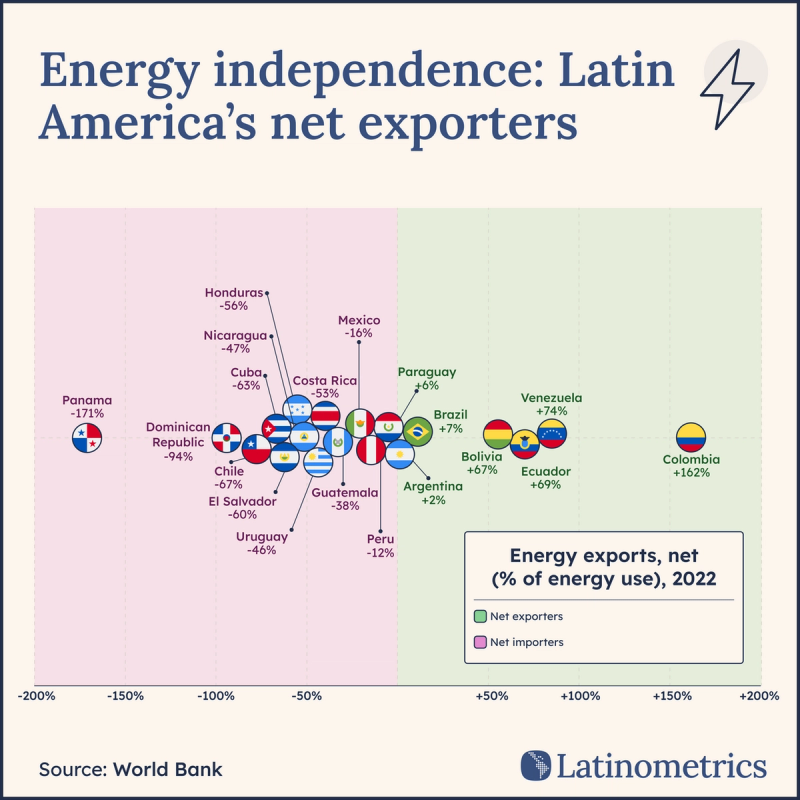
7 Latin American countries are net exporters of energy.

President Daniel Noboa's 2025 has been better than his 2024.
A recent article from economist Juan Lorenzo Maldonado outlines how, fresh off the heels of his April reelection, Ecuador's youngest-ever elected president is gearing up for a year of stronger national economic growth despite an ongoing security crisis and a looming fiscal deficit.
Noboa is tackling multiple problems at once, turning to the International Monetary Fund for loans to tackle his liquidity problem, US President Donald Trump for security assistance, and China and Spain for roughly $1B in energy financing.
The last of these comes at an opportune moment, given that Ecuador's economy contracted by about two percent last year due to rolling blackouts and electricity rationing. A drought caused water sources to dwindle, meaning Ecuador's famous hydroelectric dams were unable to power the country as expected.
Noboa is clearly interested in avoiding a repeat disaster. So far, he's been lucky, as this year has proven far rainier than last. But fortunately, his country, aided in large part by oil production, is one of Latin America's net energy exporters.
Ecuador serves as a helpful reminder of the importance of so-called energy independence.
Meeting domestic demand with internal resources goes a long way. Countries like Qatar and Norway have been able to create enormous prosperity on the backs of their abundant oil reserves, much like Venezuela did back in the day.
In fact, Venezuela is joined by its neighbor, Colombia, in using petroleum to bolster energy reserves. In fact, Colombia is the only Latin American country whose net energy exports exceed its domestic consumption (to the right of 100% on the chart). No wonder, then, that hydrocarbons are Colombia's most significant export.
Argentina and Bolivia are each blessed with natural gas, while Brazil has become the Latin American oil superstar, even before considering its impressive renewable energy grid.
On the flip side, most smaller Central American and Caribbean countries have to rely on consistent energy imports in order to meet national demand—with Panama and the Dominican Republic especially vulnerable.


