
Brazil & New Mexico drill their way to the top
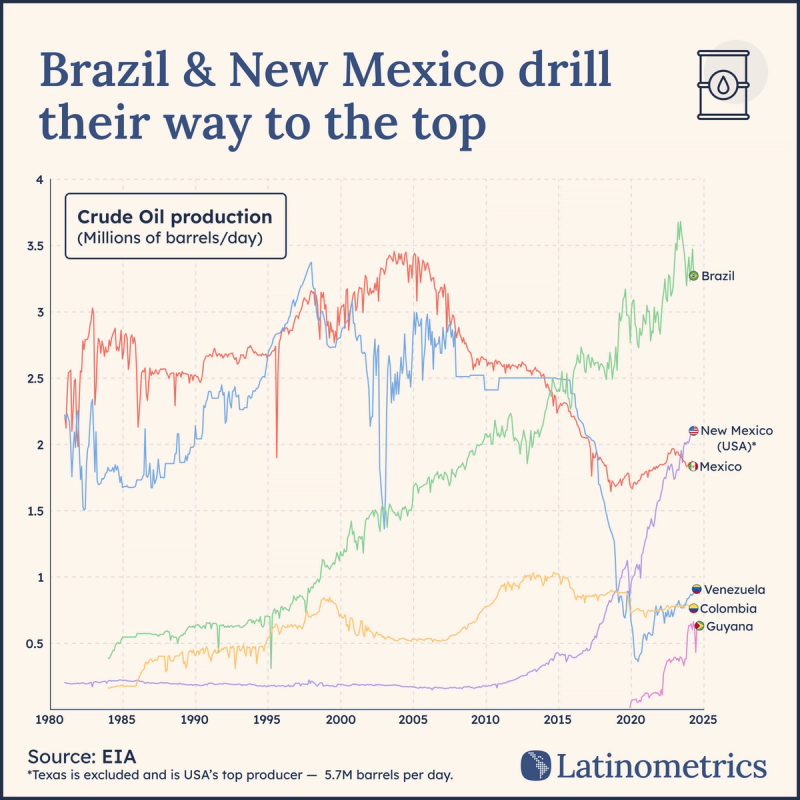
Venezuela's oil reserves are the world's largest, yet Mexico's production is higher than theirs.

The power is shifting in the oil game.
LATAM Forum in Buenos Aires
There’s an old saying that pretty accurately sums up the world of the last century.
We’re not addicted to oil—unfortunately, our cars are.
Indeed, petroleum is as core to the global economy today as electricity and the Internet, making its extraction and export highly profitable for the oil-rich. However, don’t let headlines about Norway and the Gulf states fool you—with oil, it’s not just who has the reserves, but who can effectively get it out and onto international markets.
Take Mexico and Venezuela, for example. As we discussed last week, political mismanagement and underinvestment have crippled the production – and revenues – of Mexico’s state-owned oil company (and historical Latin American leader) Pemex in recent years. Today, Mexico produces less oil than the US state of New Mexico to its north—despite the latter being roughly 85% smaller in size and nearly 99% smaller in population.
But this is nothing compared to the damage wrought by corruption and disastrous handling of PDVSA and Venezuela’s sprawling oil reserves (by far the world’s largest) by the Chavista regime in power since the late 1990s. Daily production has been decimated to levels not far off from neighboring Colombia, which is estimated to have roughly a hundredth of the proven oil reserves.
Clearly, Venezuela’s problem is in management, not in how much oil it has.
But the country’s regime doesn’t quite seem to realize, as it’s busy looking over hungrily to the newly-discovered oil next door in Guyana. Caracas has reignited a centuries-old territorial dispute with Guyana, conveniently just as the small Caribbean country has used oil exports to become the world’s fastest-growing economy.
And then, there’s Brazil. Despite scandals and oil disasters going back decades, state-owned oil champion Petrobras has turned Latin America’s largest country into the region’s leading oil producer. Historical deposits off the southeastern coast continue to be tapped, but today the big conversation surrounds how much to drill up north in the pristine Amazon rainforest.
Evidently, the petroleum business is anything but a simple one. But those “fortunate” enough to be blessed with the black gold must surely ask themselves—how long will their fortunes last? And will the coming decades see the world finally wean off its oil addiction?


