
For a foreign firm, Colombia is LatAm's fastest door in

Brazil is famously not for beginners. Mexicans have a word for the fixers who walk your paperwork through the system, the coyotes. Argentines simply say “lo atamos con alambre,” we tie it together with wire. Behind the folklore sits a very real clock; the executive told to “make Latin America work” typically has about ninety days to show a legal entity, a bank account, and a payroll.
We can forgive any international company that hesitates at reputations like these. Yet choosing the market that fits your firm may be the easy part. The hard part is opening an actual entity, and then running everything that comes after it. The devil, as they say, lives in the details.
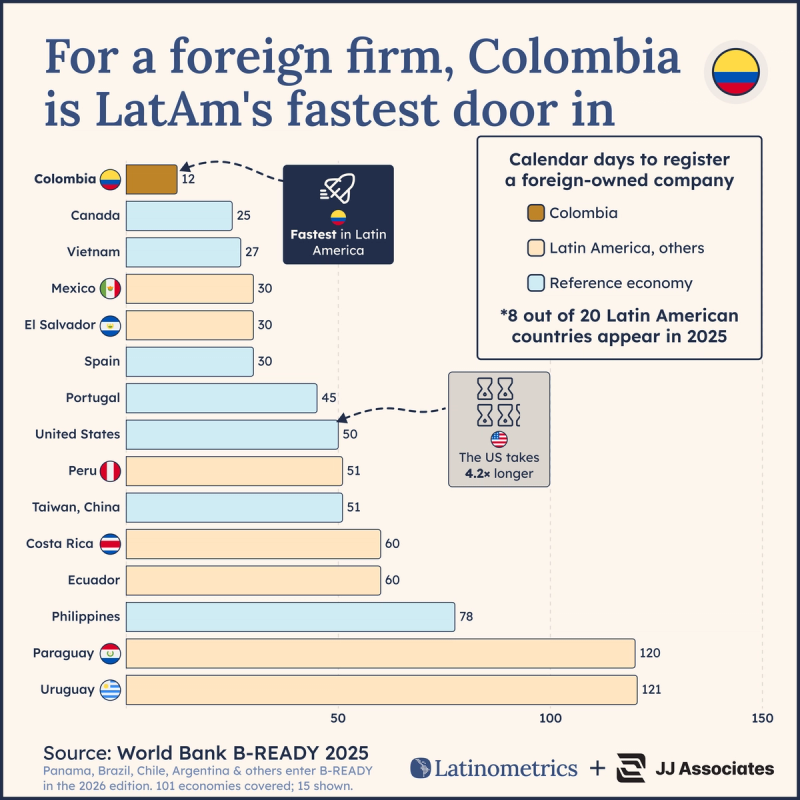
The B-READY 2025 data from our friends at the World Bank provides some idea, with Colombia winding up at the front of the pack. Business registration takes on average less than two weeks in the country. Companies have noticed. HubSpot put its Latin American headquarters in Bogotá back in 2018 and now shows 600+ employees in Colombia on LinkedIn, more than in Mexico or Brazil, markets several times the size. Electronic Arts opened its first regional hub there just last year and already lists 336 employees on LinkedIn. Bogotá keeps winning regional headquarters that its market size alone wouldn’t justify.
Brazil, the reputation that started all this, isn’t in the data yet. Neither are Argentina, Chile, or Panama; all four join with B-READY’s 2026 edition.
Which is all well and good, except registration is just the first step. Once that’s done, a company will then need a bank account, licensing, employees on payroll, and even tax arrangements to go from “technically legal entity” to an actual operating business.
As a seasoned operator in the US or Europe, you may feel like nothing can stop you; then a Latin American bank asks you to apostille every corporate document and fly a legal representative in to open the account in person.
Banking and licensing requirements change from country to country, and leadership might be insisting you break ground in several at once. For example, a payments company in Mexico waits on the fintech-law authorization the statute promises in 25 business days but that in practice can take the better part of a year. A crypto firm eyeing Peru has no queue to wait in at all; the licensing regime that would create one went back to committee in 2025 and still hasn't passed.
That’s precisely the problem JJ Associates is built to manage. Headquartered in Panama, JJ is a full-service Latin American provider covering the core of a market entry — company formation, entity management, banking, licensing, accounting, tax, payroll and employment — across 30 markets, with its own teams and offices across the region. The goal is simple: one partner instead of the four or five separate lawyers and accountants a multinational might otherwise juggle in every country it enters.
One recent engagement shows what this looks like in practice. A US contractor needed Mexico in weeks, not months, with a seven-figure contract waiting. Instead of incorporating from zero, JJ placed the company into a clean, pre-incorporated Mexican entity that was already registered, tax-active, and holding an open bank account. It was hiring inside two weeks and fully operational inside a month, about half the usual time.
Registration time is one input into a bigger question: what it will take to operate, hire, and serve the markets you've chosen. The why of a market, the opportunity it represents, is research, and it's what we publish every week. Turning that why into a working gameplan, structure, timeline, and the specific countries on your list, is where the real work starts.
Chances are you already have a market in mind and a date you're supposed to be operational by. Tell JJ Associates which countries you're weighing and when you need to be live; they'll come back with what market entry there would actually require, and what a soft landing could look like.
Source: World Bank B-READY 2025


