
From Forest to Farmland: How The Amazon Has Shifted in 3 Decades
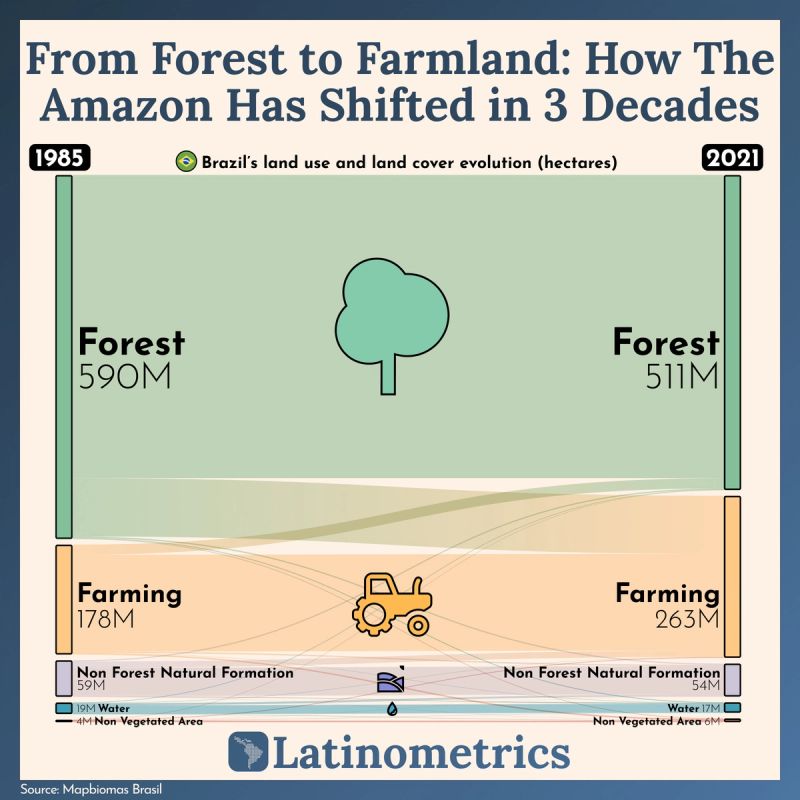
79M hectares of Amazon forest became farmland since 1985, fueling Brazil's food boom.

Last year, Brazil was one of the world’s largest food exporters. From the soybean trade with China to the halal beef and poultry industries that power the country’s trade with the Muslim world, Brazil has solidified itself as one of the world’s major food suppliers.
How?
Well, there are hundreds of ways to answer that question, but today we’ll focus on just one: land. We’ve talked about the amount of arable land in Brazil before, but we’d like to contextualize the vast amount of farmland in South America’s giant in different terms. How much of that farmland came from the Amazon rainforest? How much from the Pantanal, which is the world’s largest tropical wetland?
Between 1985 and 2021, Brazil lost 79M hectares of forestland. Much of this was turned into farmland, which grew in the same period by nearly 100M hectares. Major corporations and small farmers alike have realized that the only limit on their industries of agriculture and cattle-ranching is one of space, so they’ve increasingly turned to clearing away preserved land to grow their businesses.
We’ve all seen the horrific images of Amazon deforestation in recent years. Illegal land-grabbers have set fire to the massive rainforest which serves as the world’s lungs, allowing the flames to clear away land they can then settle. When journalists and activists, local or foreign, have tried to defend the indigenous people placed at risk by this arson, there have been terrible consequences.
Nobody wants to stop Brazil from meeting the world’s food demand, particularly as its own people seek to make a living themselves. However, the current system is unsustainable: at the 1985-2021 rate, a few more centuries would see the Amazon all but disappear, and with it the millions of people and animals which depend upon it.
So while we’re going to keep writing on the major gains Brazil is making in the world economy, as well as in pumping the brakes on deforestation, make sure to keep the Amazon, Pantanal, and other natural regions of the country in your mind.
Because once they’re gone, we won’t ever get them back.


