
Latin America's currency trading boom
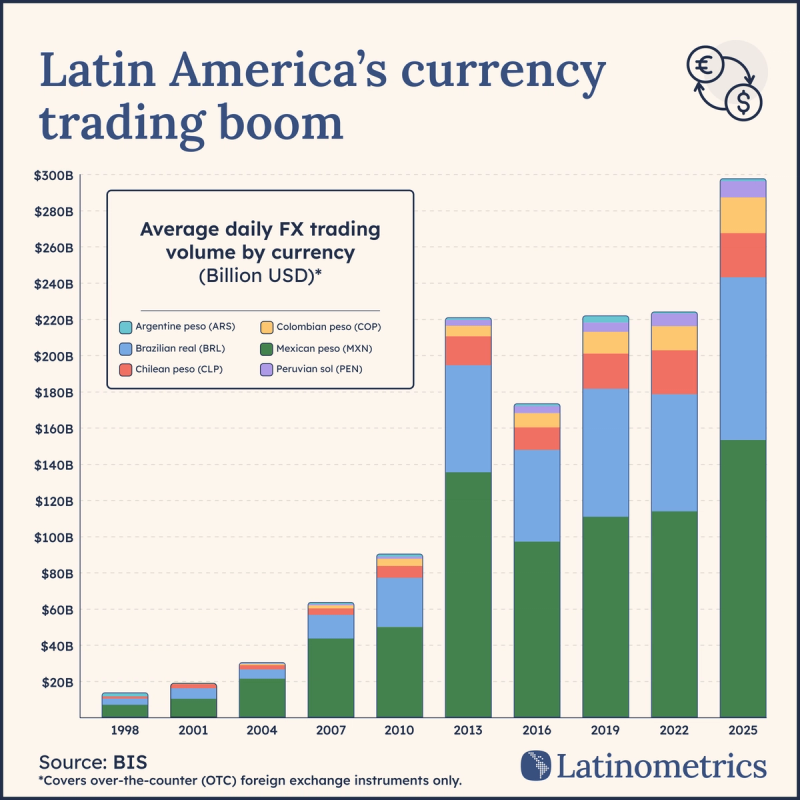
Latin American FX trading booms to $300B daily, but Mexico and Brazil dominate 90%+.

Last month’s Argentine midterms brought a ton of relief to the President of Argentina, Javier Milei, and supporters of his La Libertad Avanza coalition.
Look no further than the peso, which saw a post-election surge of 10% against the dollar following the election results, ending a weeks-long slide which had demonstrated investors’ lack of faith in Milei’s electoral success. In fact, further US assistance in the form of currency swaps and outright peso purchases may ultimately prove unnecessary.
The Argentine peso has been one of the most volatile currencies in the world over the last decade. Exactly ten years ago, one US dollar was equivalent to just shy of twenty pesos—today, that number is closer to 1.4K pesos.
International investors and even local speculators from within Argentina and Latin America have propelled a dynamic currency exchange across the region. While daily currency trading hovered around $20B at the turn of the century, today the total is closer to $300B per day.
Notably, the Mexican peso makes up the largest share of this trading, followed by the Brazilian real. In both cases, their liquidity reflects both large domestic financial systems and investor access via offshore markets, as well as favorable interest rates. In the case of Mexico, the peso has also become a stand-in for overall North American manufacturing in recent years on the back of nearshoring investments.
The relative concentration of the two largest countries’ currencies indicates that while overall regional FX activity is booming, market depth remains concentrated in a few key currencies, making them the primary vehicles for regional exposure.
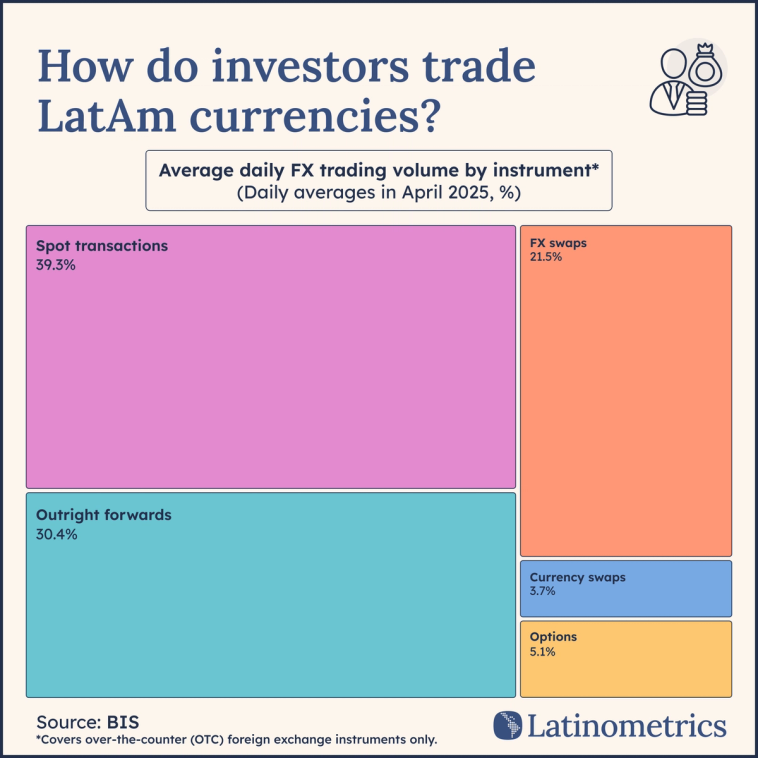
All in all, Latin American’s currency trends reverberate globally through commodities, manufacturing, and interest-rate dynamics.
For example, rising commodity prices improve Brazil’s terms of trade and drive oil futures higher, supporting the Brazilian real. Meanwhile, elevated real interest rates attract attention to currencies like the real or Mexican peso—when risk appetite falters or US policy tightens, carry reversals hit those currencies and help prompt downturns in oil futures and major indices like the Nasdaq-100.
From commodity swings and supply-chain shifts to global equity, FX, and oil markets, Latin America is today a cross-asset pressure point for worldwide investors.


