
The price of gas in Latin America
Nicaraguans pay 15% of their daily income for one liter of gas, while US drivers barely notice.

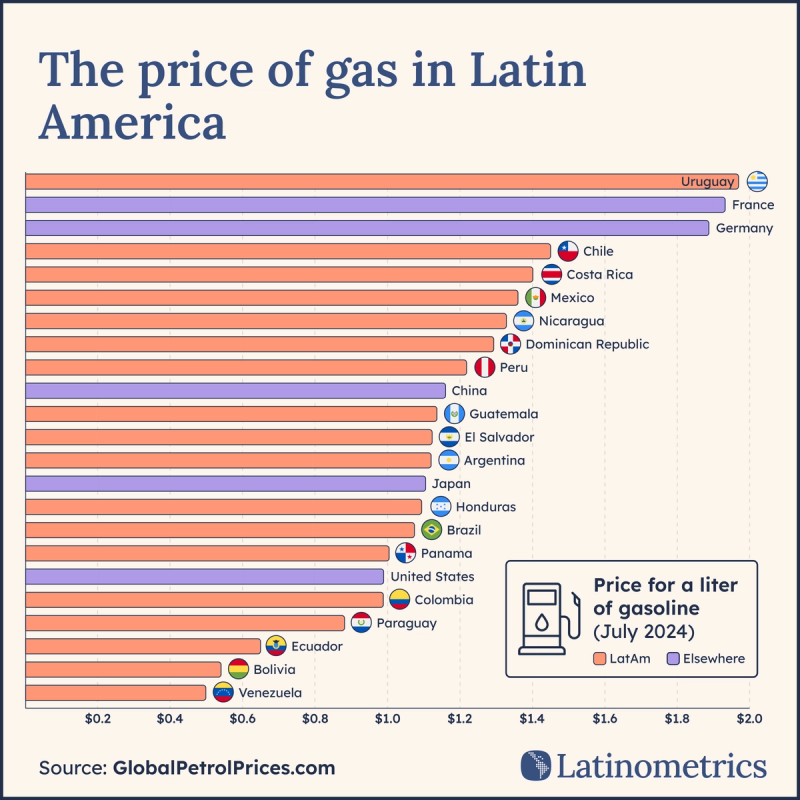
Why Nicaragua's gas prices hit wallets harder than Uruguay's.
Gas is quite expensive in Uruguay. A liter, close to $2, is more expensive than in Germany, France, and the rest of Latin America.
Gas prices are a hot topic in many countries. Gasoline is one of those so-called "inelastic" goods—people will keep buying it no matter how high its price gets because entire economies and millions of livelihoods depend on it.
In Mexico and the US, gas prices often appear in media outlets' headlines weekly or even daily. This issue, a frequent topic of discussion in North America, can influence politicians' approval ratings and, in some cases, lead to protests. Surprisingly, Google Trends data suggests that Uruguayans show minimal interest in the topic despite the high price.
One crucial factor to consider in addition to gas prices is the affordability of gas.
Uruguay's high price is nothing compared to how much the average Nicaraguan has to sacrifice to fill their tank. Buying just one liter in Nicaragua costs 15% of the average daily income.
The rest of the region could fare better, too. Compared to the biggest economies in Asia, Europe, and the US, gas is unaffordable in Latin America.
Looking at the affordability data leaves many open questions.
Why does the US population care so much about gas prices when it's relatively affordable compared to the rest of the world?
Why does the topic dominate headlines in Mexico but not in Uruguay?
Do people genuinely care about gas prices, or has it become a political and media talking point?


