
How will AI affect Latin American jobs?
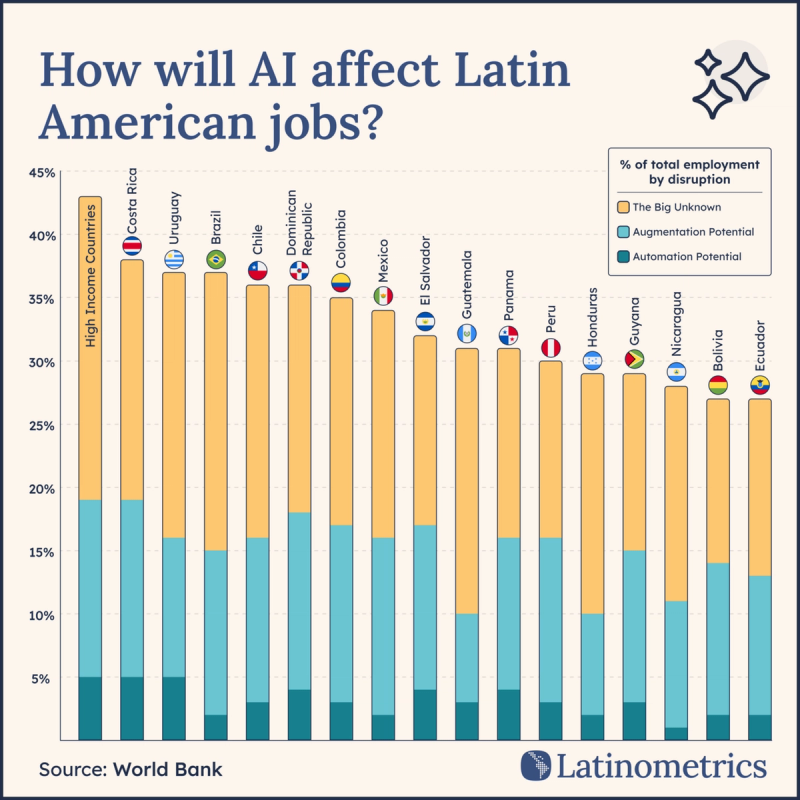
GenAI threatens 30-40% of LatAm jobs, but only 2-5% are truly at risk of automation.


Is artificial intelligence coming for your job?
In January 2023, OpenAI’s ChatGPT became the fastest-growing consumer software application in history, having crossed over 100M users since its launch two months earlier. By last month, the ChatGPT site was the fifth most-visited website in the world, behind only Google Search, YouTube, Facebook, and Instagram.
You might notice that ChatGPT is keeping company with decades-old platforms which have formed part of our everyday lives for years. Take this as just the latest sign that AI has become an irreplaceable part of contemporary society.
But not all are enthused. To many, the modern AI boom sounds more like a cause of apprehension than excitement. In particular, lots of people fear for their livelihoods in the face of a powerful new technology we still don’t fully understand.
Per a recent working paper from the World Bank, an impressive 30-40% of jobs in Latin America and the Caribbean are exposed to generative artificial intelligence (GenAI) in some way. However, don’t freak out and rob a bank just yet; this same report estimates only about 2-5% of jobs are actually at risk of being automated away.
In fact, automation risk is actually lower than augmentation potential, given that roughly 8-12% of jobs across the region could see productivity benefits from GenAI, especially in sectors such as education, health, and personal services.
And while there’s so much left to learn about the precise employment impacts coming from the AI boom, it’s worth noting whose jobs are most at risk. Not only are middle-class workers more exposed to AI, but higher-income countries more generally also have higher exposure.


