
Mexico beats the US and Sweden in low homelessness
Mexico reports 4x lower homelessness than the US, challenging developed nation perceptions.

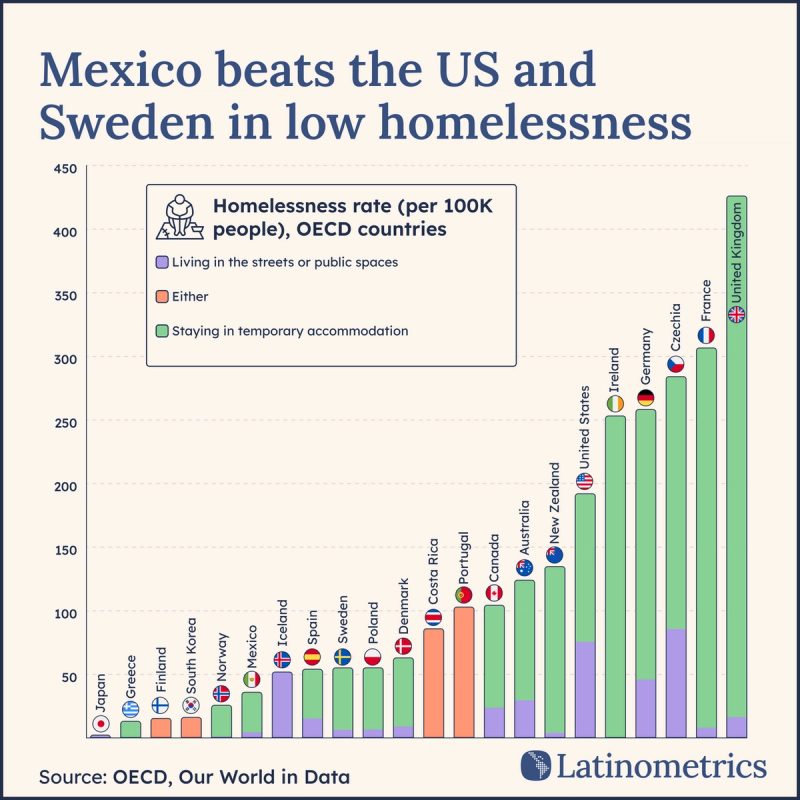
Unpacking surprising homelessness rates across developed nations.
What does it mean to be homeless? Is it crashing on a friend’s couch when times are tough? Living in a car, checking into motels or shelters when you can? Does it only apply when you’re rough sleeping, so to speak, in the streets of a town?
With different countries answering these questions differently (and homeless people being generally less documented in national registries), it can be tough to get comparable statistics. Nonetheless, there are some clear surprises among the generally developed countries of the Organisation for Economic Co-operation and Development (OECD).
For example, the United States estimates nearly 200 homeless people for each 100K of its citizens, with about 40% of these living on the streets or in public spaces. Contrast this with Mexico, which officially reports less than a quarter of this rate, and with over 85% of homeless people living in shelters or other temporary accommodation.
Costa Rica, meanwhile, doesn’t make these sorts of distinctions but still reports a homelessness rate of roughly 86 people per 100K, far below more developed European countries like France, Germany, or the United Kingdom.
Has Latin America figured out a better solution for helping its poorest citizens? Or is this just a question of underreporting?


