
How Does Voter Participation in LatAm Compare to Europe's?
LatAm consistently outvotes Europe; Brazil's 79% turnout rivals France, Norway, and Germany.


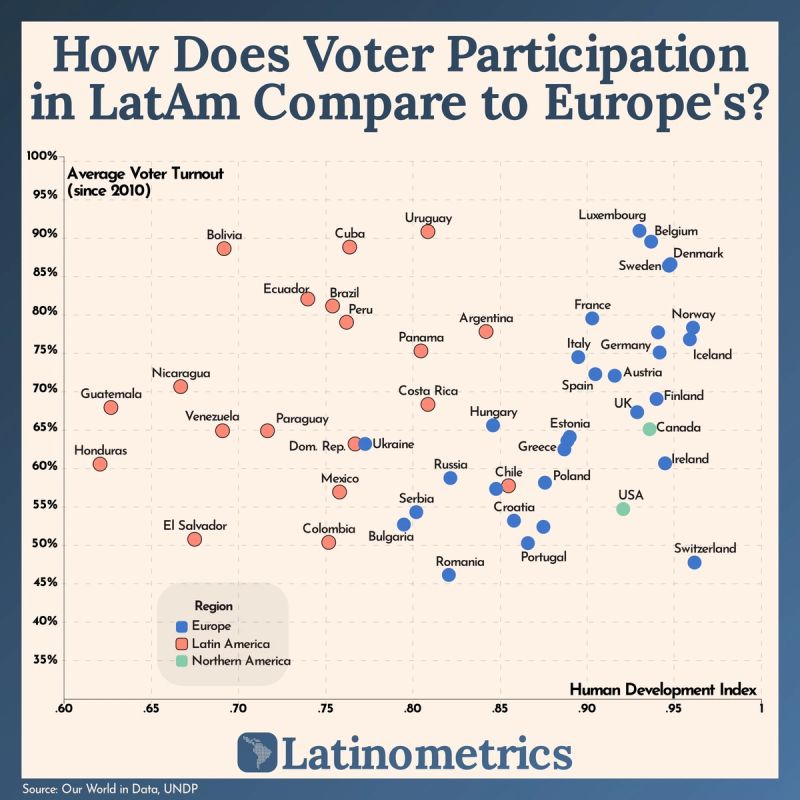
One of the most important measures of how citizens participate in national governance is the turnout at the polls. In most contexts, higher voter turnout indicates the health of democracy, whereas lower turnout is linked with voter indifference and mistrust of the political system.
Even though the number of countries holding direct elections has increased substantially since the 1990s, the global average voter turnout has decreased since 1950— with European countries leading the downward trend. Seeing people abstaining from voting in the region with the largest number of democracies is a worrying phenomenon.
Factors that impact voter turnout include population size and age, campaign expenditures, political fragmentation, registration requirements, and economic development. Naturally, we wanted to visualize how that last one relates to LatAm's voter turnout and compare it to Europe's.
Brazil sees some of the highest voter turnout rates in LatAm and higher even than France, Norway, and Germany. The 4th largest democracy held its first round of presidential elections last Sunday. An incredible 123M people waited in long lines to vote — a 79% voter turnout — with 32M abstaining. That's the same participation rate seen in the previous general election of 2018.
Also worth mentioning is Uruguay, which has had an average voter turnout of 90% — that's higher than almost all of Europe, with the sole exception of Luxembourg.


