
How Much Have Wages Changed in LatAm Lately?
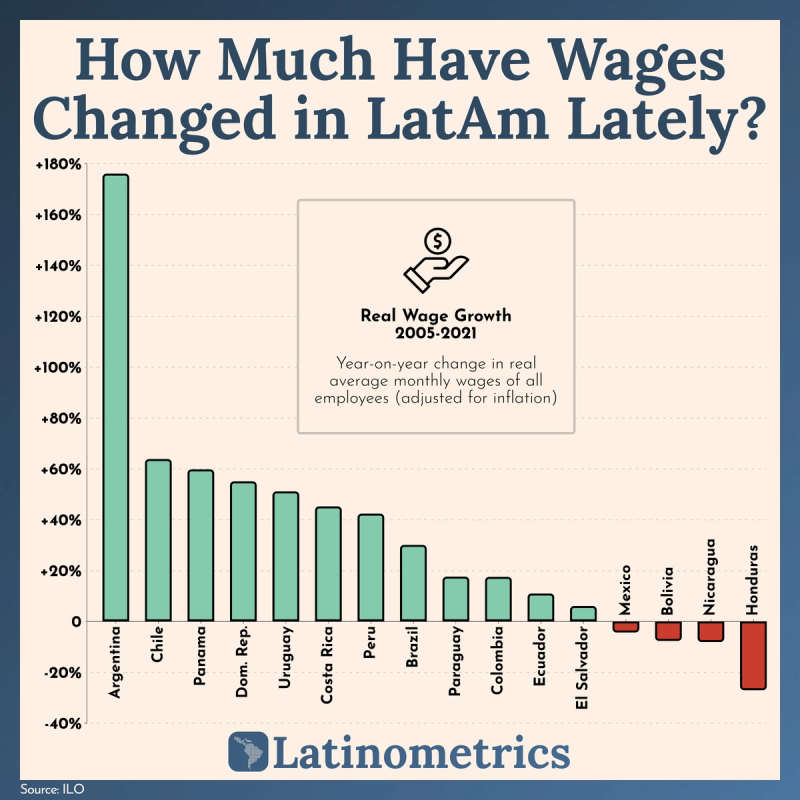
Argentina leads with 170% real wage growth since 2005, but Mexico and Honduras saw declines.

Record-high inflation has made the news around the world, and not just in the countries we come to expect like Argentina, Venezuela, and Zimbabwe. But how about the flip side, in the workplace?
Have your wages kept up with inflation? As it turns out, your answer depends in part on where you live. In the above chart, we examine real wage growth between 2005 and 2021; the ‘real’ component refers to wages adjusted for inflation (so, what you’re actually taking home, and the purchasing power associated).
We chose these years based off data from the International Labour Organization (ILO) in order to provide a bit of variety—starting in 2005 in the midst of the commodities boom which led to big-time economic growth for many Latin American countries, all the way to the height of the COVID-19 pandemic in 2021. Today, while multiple countries are fighting record inflation, it’s worth looking at how real wages have actually changed over that 16-year period.
For many countries, the story is actually a good one. Argentina leads the pack with over 170% wage growth, followed by Chile and Panama with roughly 60%. Meanwhile, however, there’s been a slight drop for Mexico, Bolivia, and Nicaragua, whereas Honduras has seen wages lose roughly 20% over the same period.
What’s at play here? It’s important to remember that higher wages come from a mixture of good policy, good business climate, and good productivity. Higher-skilled jobs powered by consistent investment will lead to better wages, particularly if there’s political appetite – and occasionally strong unions – backing them. Above all, it’s important that wages keep up with the cost of living; as crises like the pandemic showed, poverty can be a cyclical and self-feeding issue.
For higher wages to be a reality, governments and businesses must be invested in strengthening regional productivity. Only with workers moving up in supply chains and carrying out higher-skilled work can countries ensure that the average employee is able to sustain themselves and their families.


