
4 presidents, 4 inflation cycles in Argentina
Milei's inevitability: Argentina has spent more of the last few decades in recession than even Venezuela.

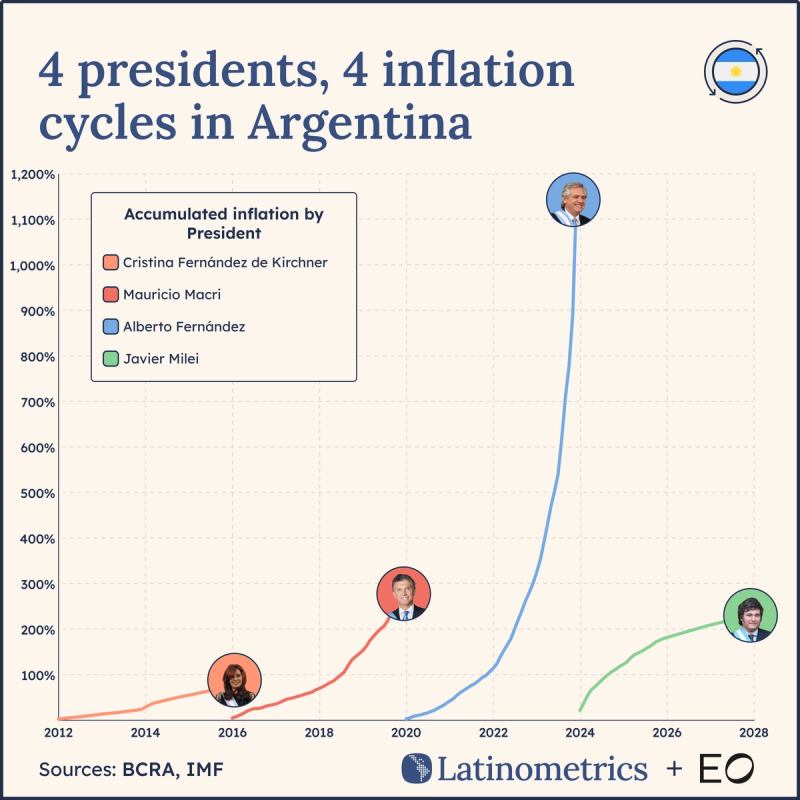
If the safest place your money can be is in US treasury bonds, the least safe place is probably in an Argentinean checking account.
This is due to Argentina’s near-chronic inflation, which has plagued the country for years and eroded both the value of peso-denominated bank accounts as well as citizens’ faith in their economy.
The current annual inflation rate in Argentina hovers around 41% per the International Monetary Fund, down enormously from its April 2024 peak when it neared 300%. A large part of this drop has been attributed to the economic shock therapy policies of President Javier Milei, whose administration was rewarded for its economic successes with a renewed electoral mandate last month.
Of course, voters would not have elected someone as radical as Milei off a few bad years alone. The libertarian president was elected two years ago following the disastrous years of President Alberto Fernández, who oversaw roughly 1200% inflation in his four years of presidency.
Yet even during Fernández’s predecessors the situation was untenable. Under the presidency of his vice president Cristina Fernández de Kirchner (no relation), who served as president between 2007 and 2015 inflation neared 100%. And in the case of Mauricio Macri, a center-right pro-business politician whose party currently serves as a Milei ally in congress, aggregate inflation more than tripled.
So with track records like these, we understand why Milei and his government-slashing chainsaw have been so successful in keeping popular support even as the national poverty rate has remained above 30%. But it’s worth recalling that Argentina’s macroeconomic woes go far beyond steadily increasing prices.
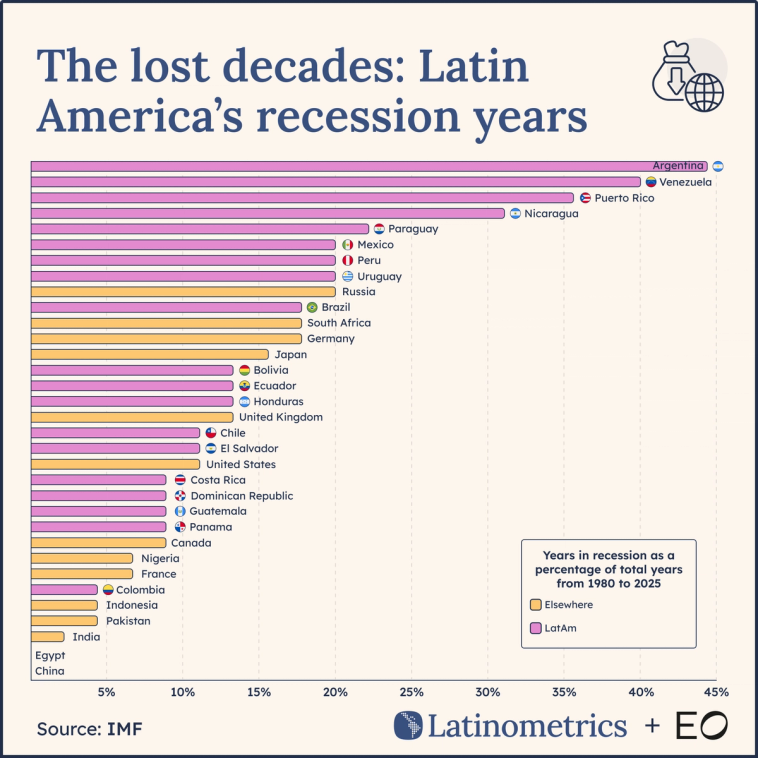
In the last 45 years, no country in Latin America has spent more time in economic recession than Argentina. Even Venezuela, the great economic catastrophe of the 21st century, has had more years of growth than its Southern Cone counterpart.
Now, perhaps Milei will truly be able to break the boom-and-bust cycles which have damaged his country’s international credibility and Argentines’ faith in their economy.
But until then, you know the old saying.
There are four types of countries: developed, developing, Japan, and Argentina.


