
LatAm Companies Need Way More Women on Their Boards
Only 8% of LatAm board seats are held by women; Europe has 3x more.

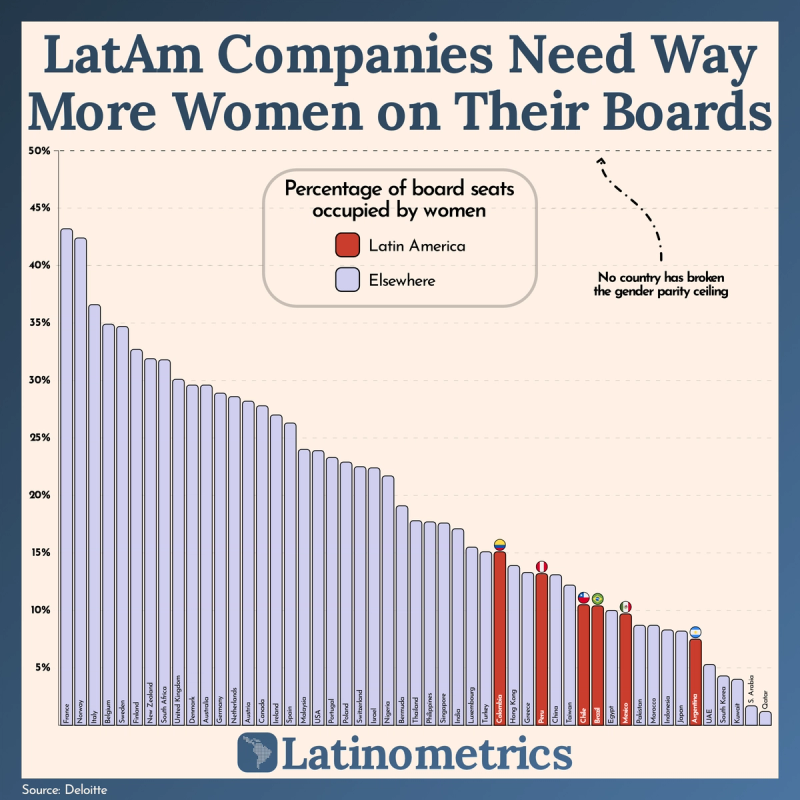
While women have made great strides in many fields in Latin America (52% of all university graduates are female, most governments in the region have a gender-diverse cabinet, and laws protecting women's rights have been abundant)… the boardrooms have not seen such progress.
According to a 2022 report by Deloitte, the average number of board seats held by women in Latin American countries is only 8%, which is significantly lower than North America (18%), Africa (24%), and Europe (25%) and even the Middle East (9%). Among Latin American countries, Argentina and Mexico report the lowest percentage of female-held seats, but no country measured is in the upper tier.
While some argue that board diversity issues will resolve themselves over time, scholars agree that gender parity will not happen without intervention. Deloitte estimates that it will take between 30 and 100 years for women to reach parity on boards and executive teams. To accelerate parity, many countries have adopted quotas. For instance, Spain passed a law in 2003 requiring 40% of board members to be female. Since then, many other countries have followed with similar resolutions.
Although there is a cost to getting more females on boards, particularly due to the outreach and search efforts involved, it is widely accepted that more diverse boards are good for business. Adding more than one woman to a board of directors positively affects four areas, according to catalyst.org: talent, innovation and group performance, reputation and responsibility, and financial performance.
The need for greater gender diversity on boards is a global issue, and Latin America has considerable catching up to do. As the saying goes, "Y también los machistas, que América Latina será toda Feminista."


