
LatAm's Soybean Supremacy: Over Half of Global Annual Production
LatAm produces 53% of global soy, but Argentina's drought shows reliance risks.

When former US President Donald Trump launched a trade war with China a few years back, he was likely not expecting to be doing a favor to Brazil and Argentina.
But the subsequent tariffs on US soybeans by China, which is the world’s largest importer of the product, opened up a ton of market space for alternative soy exporters. And South America’s two largest economies stood the most to gain from this shift.
We’ve written on the vitality of soybeans before in Latin America’s trade with China, and for a simple reason: the crop is essential to the region’s economies. Don’t believe us? Economists at the FGV’s Brazilian Institute of Economics estimate that soybean exports will make up 20% of Brazil’s total economic growth this year. That’s staggering.
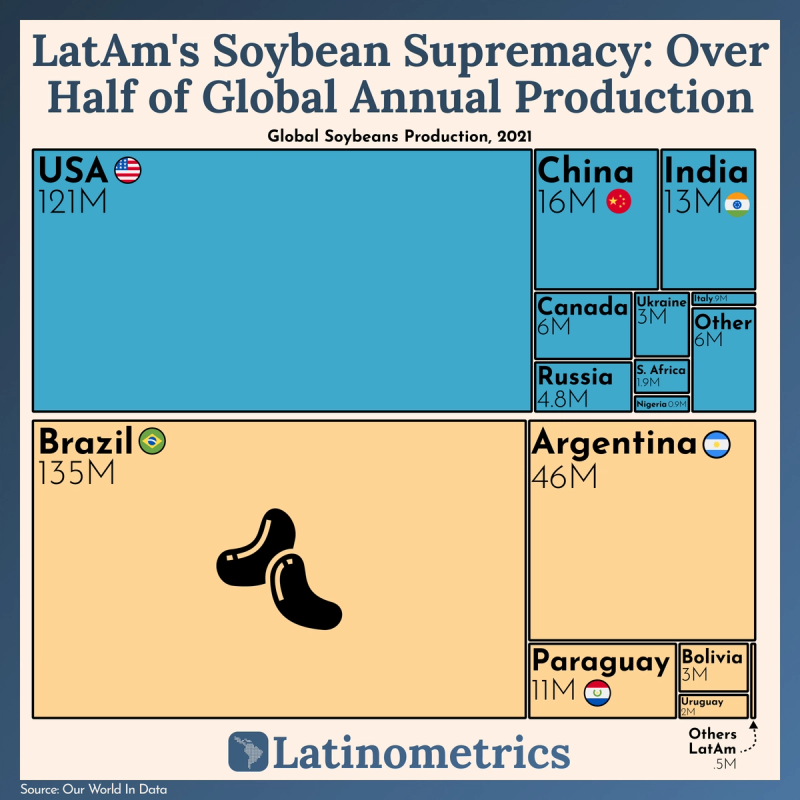
Latin America made up 53% of global soy production in 2021. Of this, Brazil and Argentina were the most significant players, outproducing top-10 economies such as China and India in the process. Other Southern Cone economies such as Paraguay, Bolivia, and Uruguay also contributed to the region’s stranglehold on the commodity.
Of course, not everything can be as rosy for Latin American farmers as a US–China trade war. Argentina’s soy production was decimated this year by drought, leading to its worst harvest since the turn of the century. This would not be ideal for a major, diversified economy, but for an agribusiness-dependent one like Argentina (or its Mercosur neighbors), it’s devastating.
While Latin America (specifically South America) is no doubt the hegemon of the soy industry, its major economies cannot remain reliant on the crop. Chinese demand will always be there to power regional growth, but commodity cycles can be tricky to navigate and have lasting consequences for development.
After all, the $9-10B lost by US soy farmers was rough on Illinois and Iowa, but the country is able to bounce back owing to its other economic sectors. But what can South America’s soy heavyweights do in times of crisis?


