
LatAm Women in the US are Having a Post-Pandemic Baby Boost
Latin American women reversed a 15-year decline in births in the US, with an 11% boost in 2021.


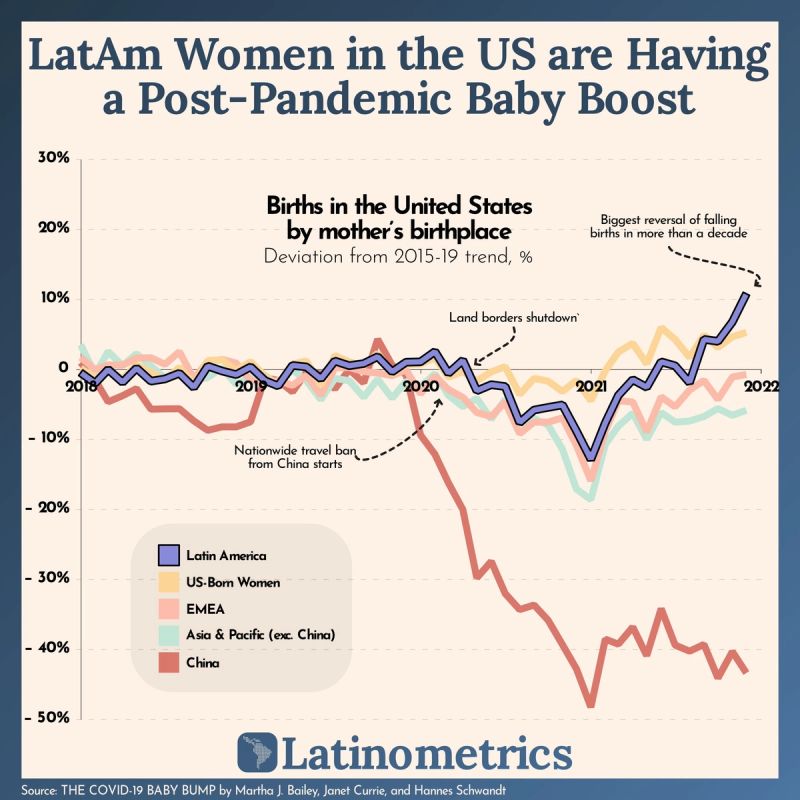
Fertility rates — aka how many babies the average woman has — have been declining for decades. Data from the US showed, to the concern of many, that the downward trend accelerated during 2020.
But research by Martha Bailey, Janet Currie, and Hannes Schwandt, who looked at the data more closely (and kindly shared it with Latinometrics), explains the why behind the drop. Their work also revealed a surprising COVID aftermath in 2021.
During the pandemic, there was a drop in childbirths by Chinese women as the US shut down Chinese travel in early 2020. A few months later, as the Mexican border closed, a decline was seen in Latin American women's childbirths.
Keep in mind the 9-month pregnancy period; it tells us that this disruption was very likely due to women not being physically present in the US to give birth to their pre-conceived children.
What's most surprising about the data the Economists presented is what starts happening in 2021. Latin American women (and also US-born women, to a lesser extent), for the first time in 15 years, reversed the trend of declining births.
By December 2021, the researchers observed an 11% positive deviation from the 2015-19 trend by Latin American women, proposing stimulus checks and increased remote work as potential explanations for the bump. What does this imply? Under the right conditions, many women are eager to become mothers.
Unbelievably for people in the Western Hemisphere, China continues to struggle with lockdowns; thus, births by Chinese women in the US are still well below the 2015-19 trendline.


