
Latin America is Home to 75% of the World's Spanish Speakers
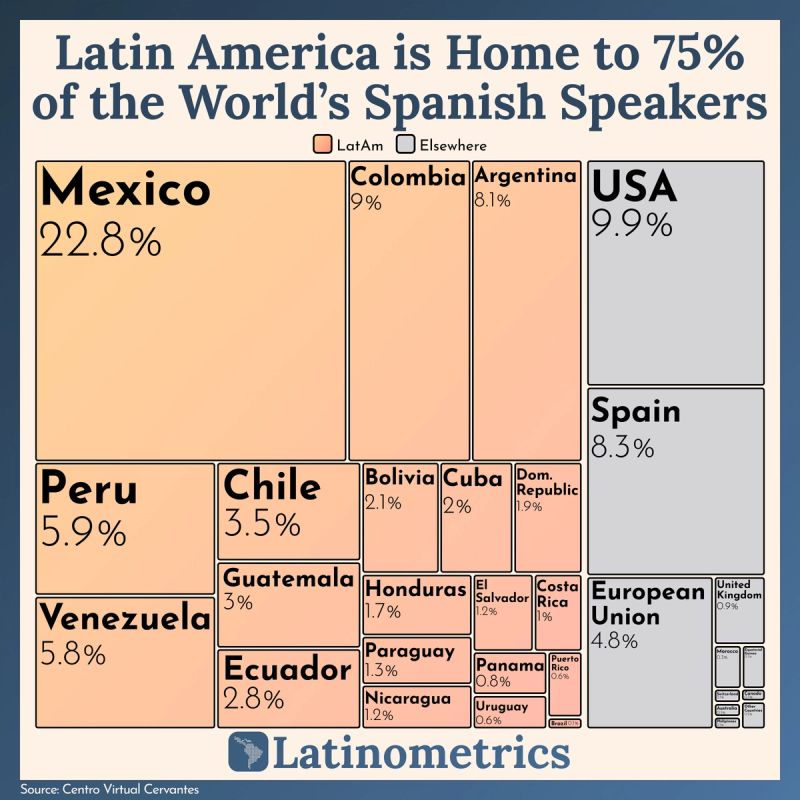
Latin America isn't just home to 75% of Spanish speakers; it's now the cultural heart of the Hispanosphere.

¿Hablas español?
Good question. And for roughly half a billion people worldwide, the answer is yes, placing Spanish among the most widely-spoken languages in history.
Naturally, Latin America accounts for quite a sizable portion of the globe’s Spanish speakers—in fact, just about three-quarters of them. Owing mostly to the historical conquests of the Crown of Castille throughout the 15th and 16th centuries, a majority of Latin Americans today speak Spanish as a first or second language, as do many of the millions of Latin Americans who have left the region to live elsewhere.
The result? Spain, with its roughly 47M people, has today been replaced as the standard-bearer of its own language by Latin American countries such as Mexico and Colombia, which are the world’s most populous Hispanic-majority countries. The rest of the 27-member European Union, meanwhile, contains nearly 5% of all Spanish speakers.
Interestingly, the United States actually holds the second-largest Spanish-speaking population worldwide with just under 10% of the global total, in large part due to the millions of Latinos who have made the US their home over the years. It will likely even surpass its southern neighbor to take first place by 2050.
Now, what does this all matter? Languages are languages, right? Well, even setting aside the region’s largest country – Brazil – on account of its citizens mostly speaking Spanish’s strange cousin Portuguese instead, it’s clear that Latin America will continue to be the cultural center of the Hispanosphere for decades to come.
Just think: Mexican telenovelas are renowned the world over. Colombia and Puerto Rico have the music world on lock in recent years with global superstars such as J Balvin and Bad Bunny. Argentina, 1985 just locked down the Golden Globe Award for Best Foreign Language Film in January.
In sum: Spain can keep Carlos Ruiz Zafón and La Casa de Papel. In arts and business, culture and linguistics, Latin America has taken a central role on the global stage. Some may see the prevalence of Spanish over another language such as English or Mandarin as a barrier; but we see it as a propellant for the sorts of regional integration and transnational problem-solving that we know the region needs.


