
US Remittances to Mexico Have Exploded Since 2020
Mexico's remittances hit $63B, 70% above pre-pandemic levels, yet dependence raises mixed feelings.

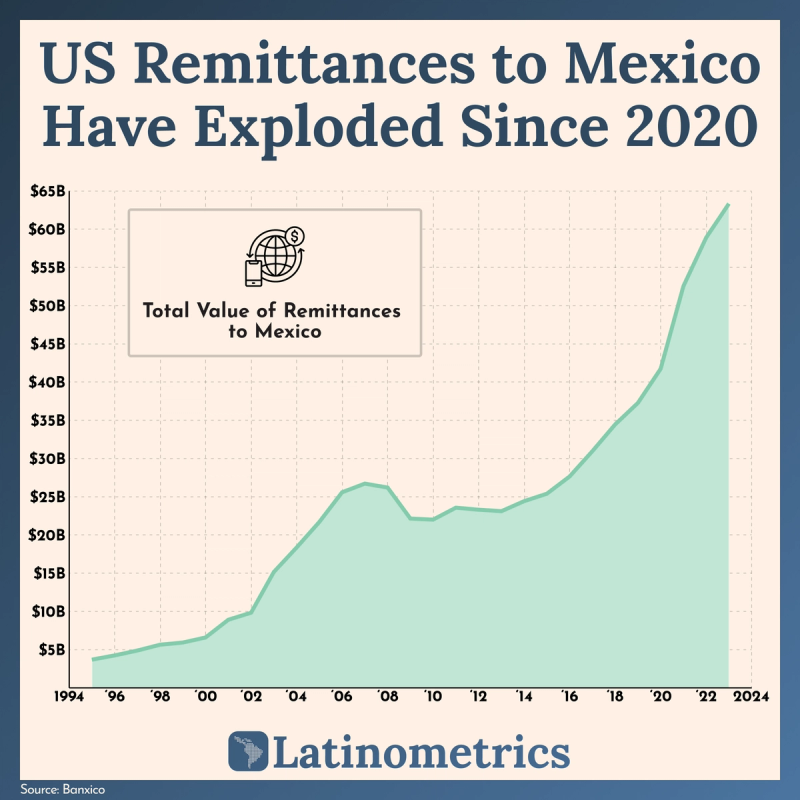
Almost four straight years of growth and its significance in the economy.
Forty-six months in a row. That's how long remittance volume in Mexico has grown (compared to the same month of the previous year). The $63B that Mexicans abroad sent home last year is 70% more than pre-pandemic levels and almost 3x the amount they were sending ten years ago.
Remittances are not just numbers on a balance sheet. They play a vital role in the Mexican economy, equal to about 13% the amount of the government's budget. Unlike the budget, most of this money goes straight into the pockets of hardworking Mexicans and their families, making a tangible difference in their lives.
This flow of money, which is about the size of Costa Rica's entire GDP, goes to the families of migrants in the US. Despite Mexico's expanding job market, families' dependence on these transfers is increasing. According to INEGI, remittances represented 17% of the average Mexican's income in 2022.
This dependence is quite relative. Despite its massive remittance market, second only to India, Mexico's economy as a whole is much less dependent on remittances than some of its neighbors in Central America. Notably, Honduras's GDP is 27% remittances, while Mexico's GDP is only 4%.
Remittances bring mixed feelings. On one hand, they represent an avenue for millions to feed and even thrive through hard work. On the other, they represent a need for more prospects to do so back home, and some theorize that money laundering and drug trafficking are behind part of the growth. Realistically, these flows of money aren't going anywhere, but the less dependent a country's citizens can be on them, the better that country is doing in opportunity creation.
If you're interested in reading more about remittances, we wrote a deep dive with a more regional perspective and technology companies' role in the industry last year.


