
Argentina's peso growth outpaces the US dollar
Argentina's soaring peso delivers rapid disinflation, but risks making the country less attractive for tourism and exports.

A strong peso can open doors — and close others.
It wasn’t too long ago that Argentina was the cheapest vacation spot around for Chileans, Paraguayans, Uruguayans, even southern Brazilians.
The country’s decades-long economic crisis and dwindling foreign reserves weakened international confidence in its currency, the Argentine peso, making the country cheaper for those who came from abroad. Today, that scenario has flipped back, with the Brazilian beaches of Florianópolis and Buziós once more becoming hotspots for Argentines seeking some sun at a favorable exchange rate.
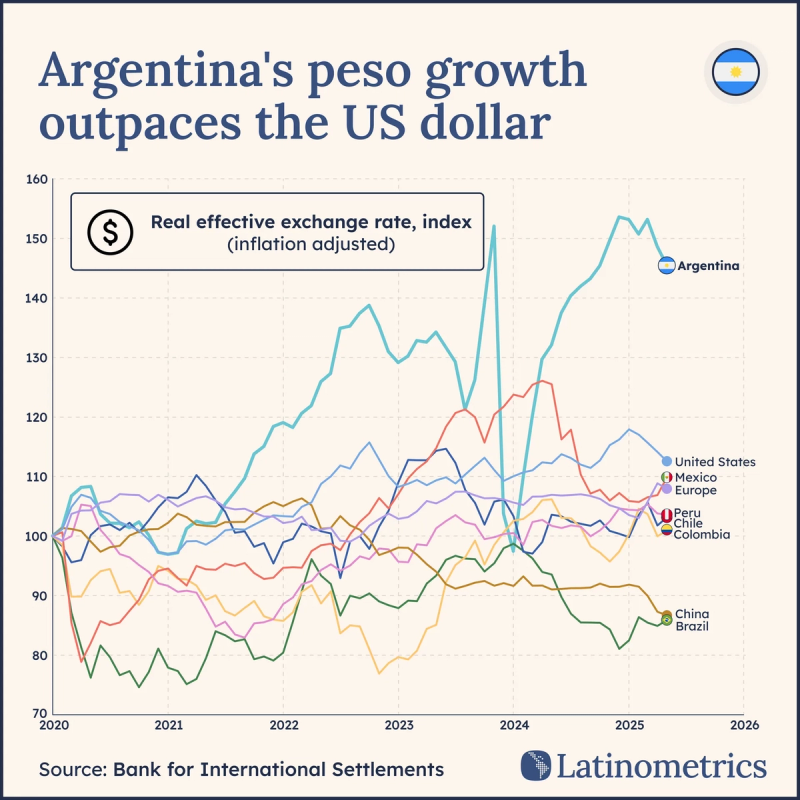
Late 2023 saw a plummet in the real exchange rate (RER) index, which compares the peso to a basket of international currencies from Argentina’s major trade partners, as newly-elected president Javier Milei cut the peso’s value in half by lifting currency controls which had artificially propped up the currency.
But just look at how far it’s climbed since.
A stronger peso has delivered rapid disinflation, a normalized FX market, and easier access to imported goods.
Today, the Argentine peso has soared in value when compared with other major currencies such as those of its neighbors as well as top trade partners such as China, the United States, and the European Union. International speculators have largely rewarded the Milei government for what many deem as necessary fiscal and monetary reforms—a drop this year has been seen basically across the board (notably, minus the euro) due to the global tariffs imposed by the US.
However, trade raises another critical point, which is the effect of a stronger currency. A weaker RER means that national goods are cheaper to export, while imported foreign goods become pricier; this is why countries like China often devalue their currency in order to stimulate their exports.
With a strong peso, Argentina may become slightly less attractive as both a tourist destination and exporter, though the latter is of course also greatly shaped by global commodity prices and natural conditions.
The Argentinian peso’s rise shows credibility can be built — but not without cost.


