
Argentina & Canada have the safest cities in the Americas
Montevideo is more dangerous than Bogotá, but Buenos Aires and São Paulo defy expectations.

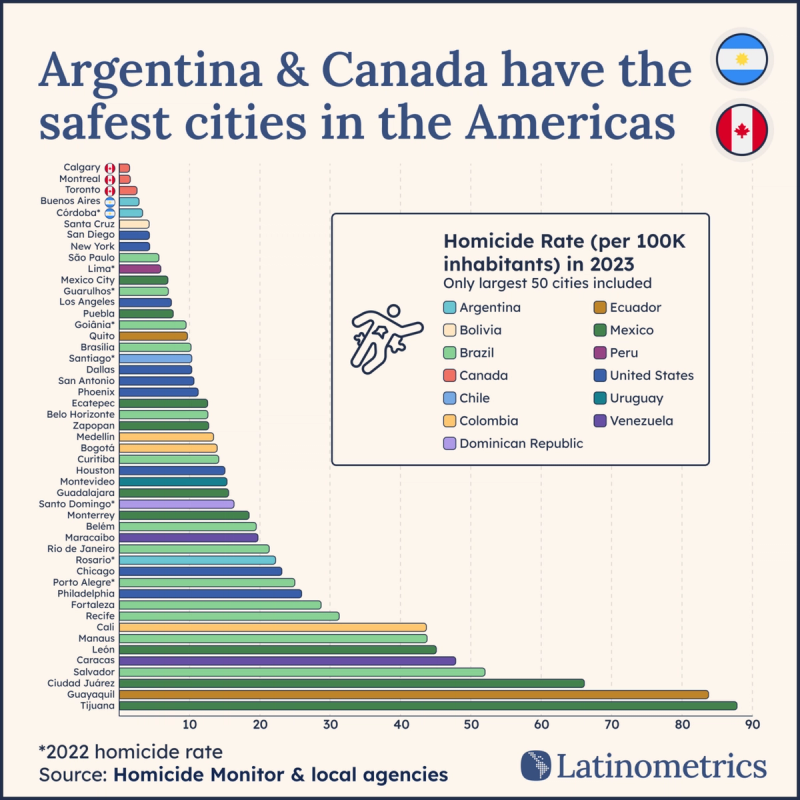
A look at homicides in the 50 largest cities in the Americas.
When Uruguayan voters hit the ballot box on Sunday, they had a few things to consider. Would they stick with the path of the governing National Party or return power to the leftist Broad Front? Would they vote to reform the social security system? And would they accept nighttime police raids?
The last of these questions is tied to a key concern for voters in Uruguay—and the rest of Latin America too.
Now, the Uruguayan capital of Montevideo is actually less safe than many might think, with a higher homicide rate than Colombian peers like Bogota and Medellin.
Go across the bay from Montevideo, though, and the story is quite different. Despite years of economic crisis, Argentina has got some of the safest cities in the hemisphere. Only Canada outperforms.
Buenos Aires isn’t alone in being a lot safer than many foreigners might expect. It’s joined in this metric by the two most populous cities in the Americas, São Paulo and Mexico City.
Even Rio de Janeiro has an overblown reputation for danger, particularly as the carioca capital has made massive advancements since the 1990s and today sees a lower homicide rate than both Chicago and Philadelphia.
In fact, a number of Brazilian cities are more dangerous than the movie immortalized in City of God and other world-famous favela stories. Most are in the north or northeast, like Salvador, Manaus, and Recife. Interestingly, even the country’s southernmost state capital, Porto Alegre, is more dangerous by this metric.
If Brazil has some unsafe cities, it pales in comparison to Mexico. Border municipalities like Juarez and Tijuana are the most dangerous large cities in Latin America, serving as hubs for narcotrafficking and international smuggling.
This is hardly a new development for these border cities. However, in recent years, they’ve been joined by Ecuador’s primary port city, Guayaquil, which has seen an explosion of violence as international cartels have moved into the small Andean country to take advantage of favorable trade terms.
At over 80 homicides per 100K people, Guayaquil could feasibly become Latin America’s most dangerous large city in the years to come. No surprise then that President Daniel Noboa recently extended a state of emergency across Ecuador in an effort to stamp out crime.
Crime is the defining issue of this decade—let’s see if governments are up to the task.
For context: A financial oligopoly is a market structure where a small group of dominant financial institutions control a large share of the market, limiting competition and often influencing regulatory and economic policies to maintain their power.


