
Smarter bottling could halve matchday soda's footprint
Behind every matchday drink sits a carbon footprint that smarter factories are already shrinking.



That ice-cold soda you're having while you watch your team get pummeled by Argentina on football's biggest stage? It could use up so much less energy.
Now, a soda during a soccer match hardly sounds like it's consuming data center levels of energy. But multiply that one sugary drink by millions of fans in over 100 matches across sixteen host cities, and the footprint starts to look very different.
Based on stadium capacity, the upcoming tournament schedule, and our own reader survey on sports-viewing habits, we estimate that live spectators at the world's greatest football tournament will drink around 3.6M liters of soda this summer.
Simply producing that much soda carries a real climate cost: roughly 128 tonnes of CO2 and 361 MWh of energy at current bottling intensity—but smarter manufacturing can change the equation altogether.
Using Coca-Cola Europacific Partners (CCEP)'s reported efficiency gains as a real-world reference, for example, modern bottling can cut that carbon footprint in half while trimming energy use too. Not bad when we're talking about fizzy drinks at a game.
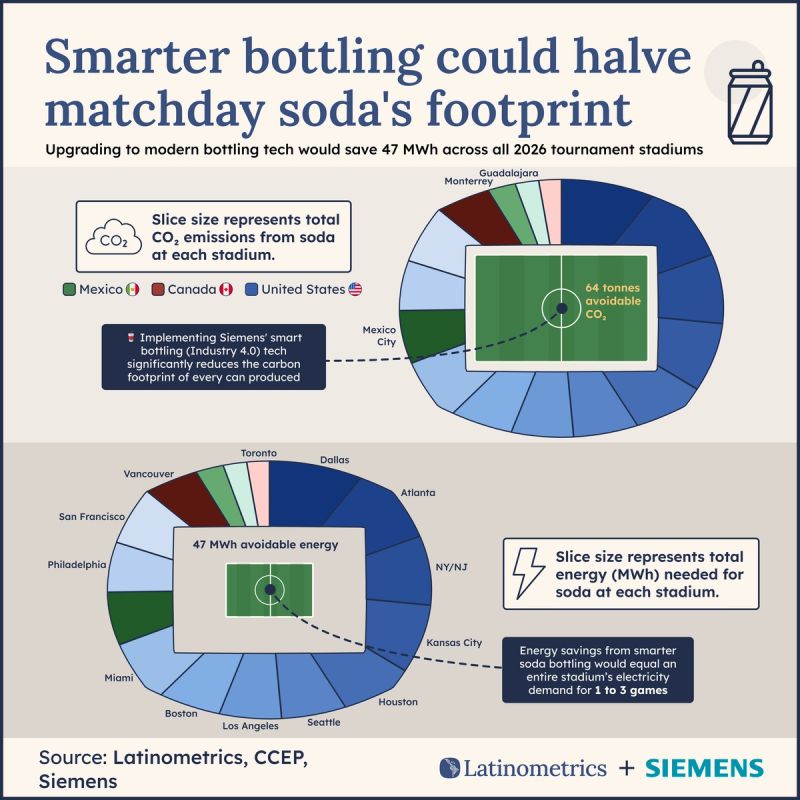
To help visualize this a bit better, we built today's chart, which turns the invisible footprint of modern bottling into two soccer stadiums, one for energy and one for CO2. Each section of the stands represents a stadium host city's CO2 footprint and energy associated with soda consumption. Naturally, bigger venues and cities with more games occupy more space.
Smarter bottling could halve matchday soda's footprint
At the center of each, the pitch represents the savings potential of smart manufacturing. We drew it to scale against the stands to make the impact clear: the avoidable carbon footprint equals half of the tournament-wide total, while the energy saved would still power a stadium for a full match or two. In emissions terms, the tournament-long savings from smarter bottling alone would offset the equivalent of the Wolverhampton Wanderers' team travel across a full season.
And Mexico is at the center of this story, as both the first ever three-time host as well as a key market for Coca-Cola Europacific Partners, one of the world's largest soda bottlers.
In fact, the company's bottling performance highlights the possibilities for how industrial modernization can turn small per-liter improvements into significant savings at scale. By some counts, you could lower CO2 emissions by the same amount as if you took thirteen cars off the street for a year.
Nor is this potential limited to a single facility or country. German engineering giant Siemens has worked with international bottlers on factory-level efficiency projects worldwide, including a Swedish plant where energy use and greenhouse gas emissions dropped by thirteen percent in under a year.
Of course, none of this means you need to give up that sweet iced beverage, which helps you accept your team's loss to an unstoppable Argentinean squad. Sometimes the biggest gains happen long before you ever buy that drink from the snack bar.
| Input | Value | Source |
|---|---|---|
| Soda per fan, per match | 0.85 sodas (≈0.6 L) | Latinometrics reader poll (n=139) |
| Total soda, live spectators | ~3.6M liters | Latinometrics estimate |
| Baseline energy intensity | 0.36 MJ/L | CCEP (2024) |
| Baseline CO₂ intensity (Scope 1+2) | 35.5 gCO₂e/L | CCEP (2024) |
| Energy saved with smarter bottling | 13% (≈47 MWh) | Siemens |
| CO₂ saved with smarter bottling | 50% (≈64 tonnes) | Siemens |
Source: Latinometrics analysis; CCEP (2024); Siemens; reader poll (n=139)


