
Taiwan Recognition at its Lowest, Even in LatAm
Taiwan's allies dwindle to just 13 nations, pressured by China's $310B LatAm trade.

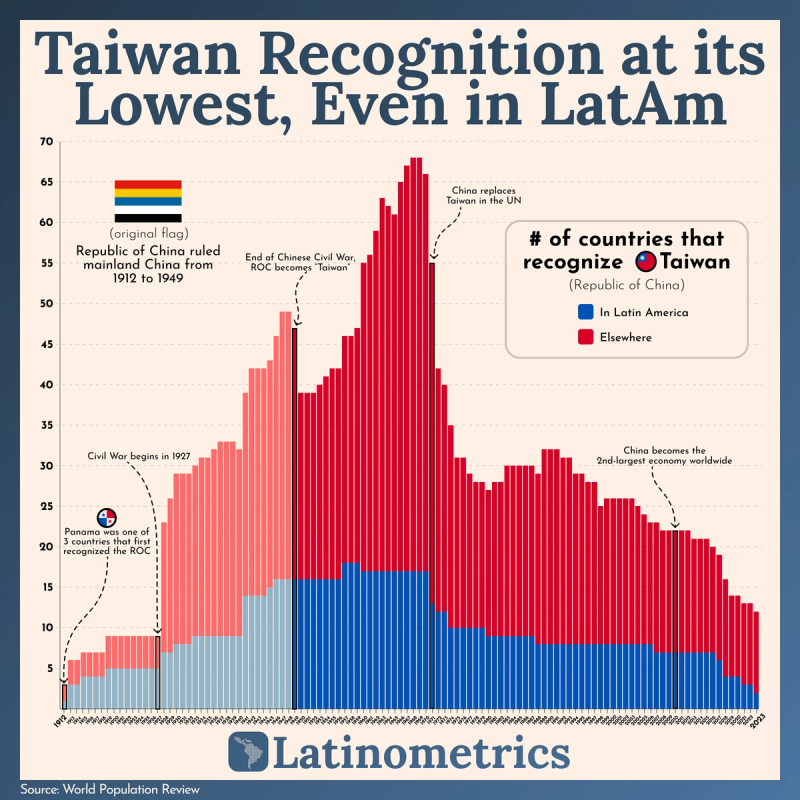
Guatemala and Paraguay have one thing in common besides Spanish speakers and good food: they’re the final two Latin American countries to still recognize the Republic of China—or as it’s more commonly called, Taiwan.
And it’s a small club: only 13 countries in the world still recognize the self-governing island of 23M people as independent.
What’s the story around Taiwan? Well, historically the Republic of China (ROC) governed all of mainland China plus Taiwan. That is, until 1949, when the ROC lost the Chinese Civil War. Their communist enemies promptly established the People’s Republic of China, or PRC (what you think of when you hear China).
What happened to the ROC? Well, they fled to the island of Taiwan and set up base there. Since 1949, there have been two governments, each claiming to be the legitimate representative of China—and recognizing one means forgoing ties with the other. While at first most governments chose to maintain relations with the government in Taiwan, by the 1970s the mood had changed and the PRC—mainland China—had become the favorite. Taiwan even lost its United Nations seat in 1971.
In addition to Guatemala and Paraguay, half of Taiwan’s remaining formal allies are in the Americas, largely sprinkled throughout Central America and the Caribbean. The pressure to recognize China instead of Taiwan is intense: China is the world’s 2nd-largest economy, has bilateral trade with the region exceeding $310B, and offers significant opportunities in investment and financing.
Honduras is the most recent country to have switched ties over to recognizing China, having announced its decision just a few weeks ago. The question whether to follow suit has meanwhile become a big focus in this month’s general election in Paraguay, the largest country by area to still recognize Taiwan—it’s anyone’s guess how that will turn out.
A century ago, East Asian diplomacy wouldn’t have had much impact on Latin America. Today, however, the issue of Taiwan has become just another example of how globalization has shaped the region’s politics and development. Whether visits from the Taiwanese president or capital from China’s massive banks, Latin American countries today find themselves at the center of this diplomatic struggle.


