
The BRICS Overtakes the G7 in Global GDP
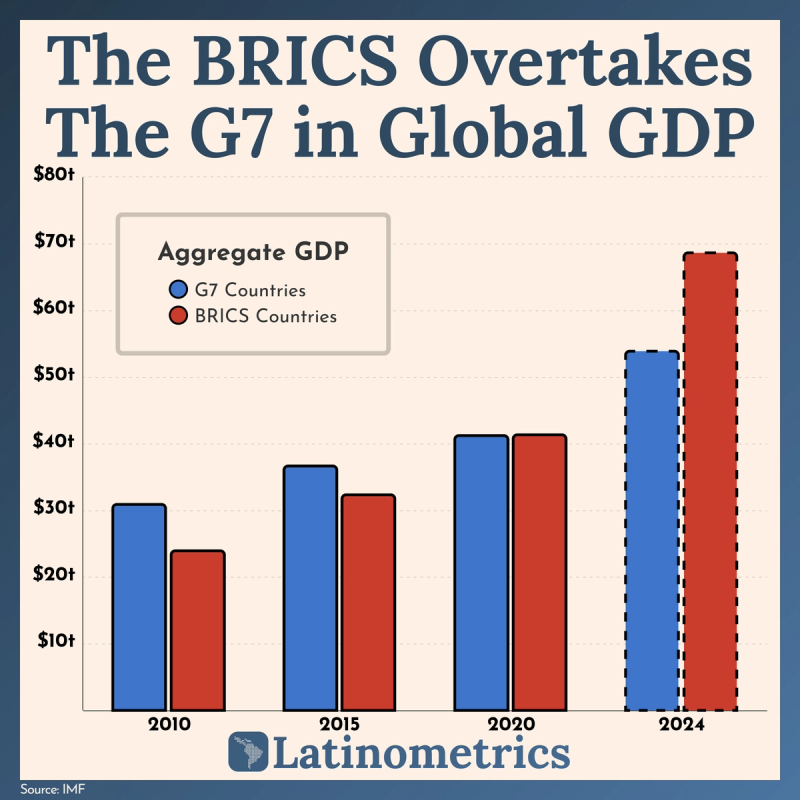
BRICS now outpaces the G7 in GDP, with new members solidifying a trend brewing since 2020.

Obviously, we’re most excited for Argentina’s accession, which is doubling the amount of Latin American representation in the BRICS. Meanwhile, the remaining new members serve as a pretty large entry into the greater Middle East and Northeast Africa region.
As a result of these new members joining, 2024 will solidify a trend long in the making, which is the now 11-member BRICS surpassing the Group of Seven (G7) in terms of nominal gross domestic product—though technically this has already been the case since 2020, if only by a little bit.
The G7, which originated in the 1970s, is an intergovernmental forum bringing together Canada, France, Germany, Italy, Japan, the United Kingdom, and the United States (as well as the European Union). The roster spans some of the traditionally largest economies in the world, as well as the standard-bearers for Western liberal democracies.
Notably, there was a period of overlap between the two groupings, back when BRICS member Russia was part of what was then called the G8—that ended in 2014 when it was suspended following its annexation of Crimea.
Now, the G7 has long been dominated by its largest economy, the US, and BRICS is looking like it’ll be similar with its own largest economy in China. Geopolitics aside, however, what we’ll be watching is whether blocs like the expanded BRICS can deliver tangible results for its Latin American member countries.
Today Brazil and Argentina; tomorrow, Mexico?


