
The State of Peace in Latin America: A 10-Year Analysis
Latin America's peace declined over 10 years, with 7M Venezuelans displaced and El Salvador's incarceration surge.

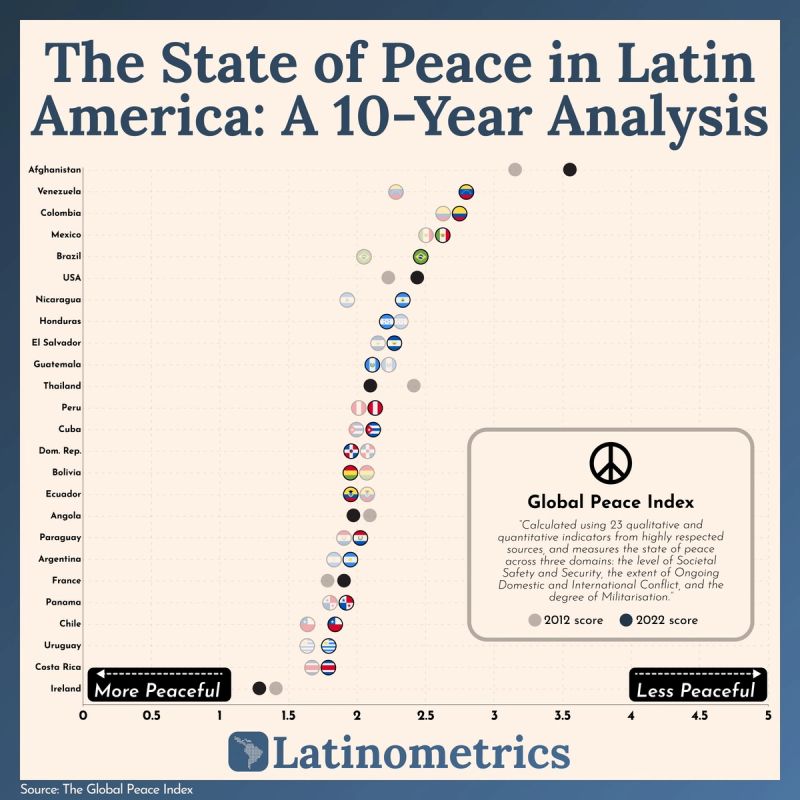
Oh 2012, how far away you seem. Particularly when we consider peace.
Crime has risen across Latin America, to the extent that some leading analysts have predicted that this decade crime will play a similar role as corruption in the 2010s, a defining issue by which regional governments live and die.
But outside of simply soaring crime, national peace more generally appears to be on the defensive across the hemisphere. To track this, we’ve compared two editions of the Global Peace Index, which aims to measure peace through 23 indicators including political instability, organized conflict, and degree of militarization. By these metrics...well, outside of a few outliers such as Guatemala and the Dominican Republic, it’s not looking too great for our region’s progress.
Why the decline in peace scores? Well, it really depends on the country. Rising homicide rates have their part to play, but so do growing numbers of refugees and internally displaced people—including, say, the 7M Venezuelans who have fled to neighboring countries since 2012. Despite the drop in homicides under the current government of El Salvador, the country’s high number of incarcerated people—roughly 2% of the total population—certainly plays a role in the country’s drop in score. As for Mexico, the growing presence of the military and consistent political terror have contributed to a a drop similarly seen in Colombia and Peru.
From the big drop in Brazil to slight decreases in regional stars such as Chile and Costa Rica, Latin America overall has seen a notable shift over the last decade. Much like its northern neighbor, the region has lost ground in terms of securing more peace for more people, something which holds clear implications for economic growth and widening opportunities.
We won’t pretend the challenges of state violence, instituional weakness, or internal conflict are easy to overcome. However, whether it be Colombia’s peace accords with rebel groups or Brazil stepping back from the brink on democratic erosion, we know overcoming them are not just essential, but feasible.


