
The Wild Variation of Female Participation in the Labor Market
South Sudan's female labor participation outpaces Switzerland, revealing culture's surprising influence.


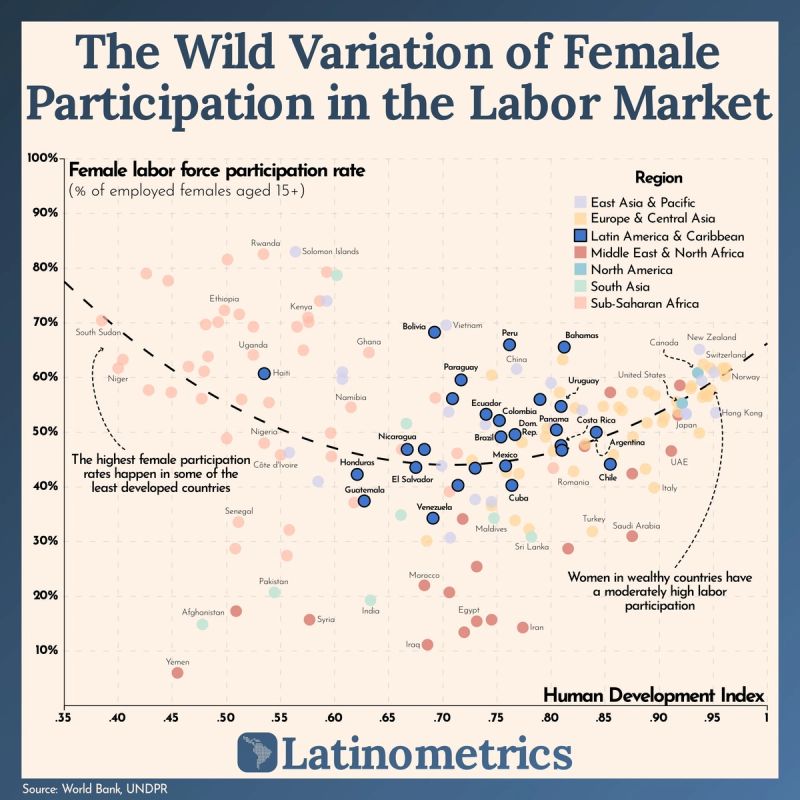
Intuitively, we might expect that as countries become more developed, they also become more socially mature and welcoming of women's participation in the labor market. That trend is accurate, to some extent. Based on that correlation, we would predict wealthy nations to have the highest participation of females in the workforce, but that is not the case.
South Sudan, which has 80% of its population living in extreme poverty (highest in the world), has a higher share of female participation in the workforce than the world's most prosperous nations like Switzerland and Norway.
You don't have to go as far as Africa and Europe to find a dichotomy — there are also stark contrasts within Latin America. Consider Venezuela and Bolivia: both have a Human Development Index of 0.69, and yet, in Venezuela, 34% of females participate in the workforce, while 68% (double) of them do so in Bolivia.
What do these extremes tell us about the female labor force? Although the metric displays a trend partly explained by countries' development, it's ultimately strongly influenced by their culture and values. Author William MacAskill talks about how the entrenchment of cultural values in societies are highly influential drivers of the world's outcomes.
William's new book, 'What We Owe the Future,' inspired this chart. It also inspired an extraordinary Kurzgesagt video that explores the philosophical question: "Is our civilization on the brink of collapse?"


