
Timeline: LatAm's 20 Biggest Stadiums
Newer LatAm stadiums are smaller, optimized for experience, not capacity, unlike 20th-century giants.

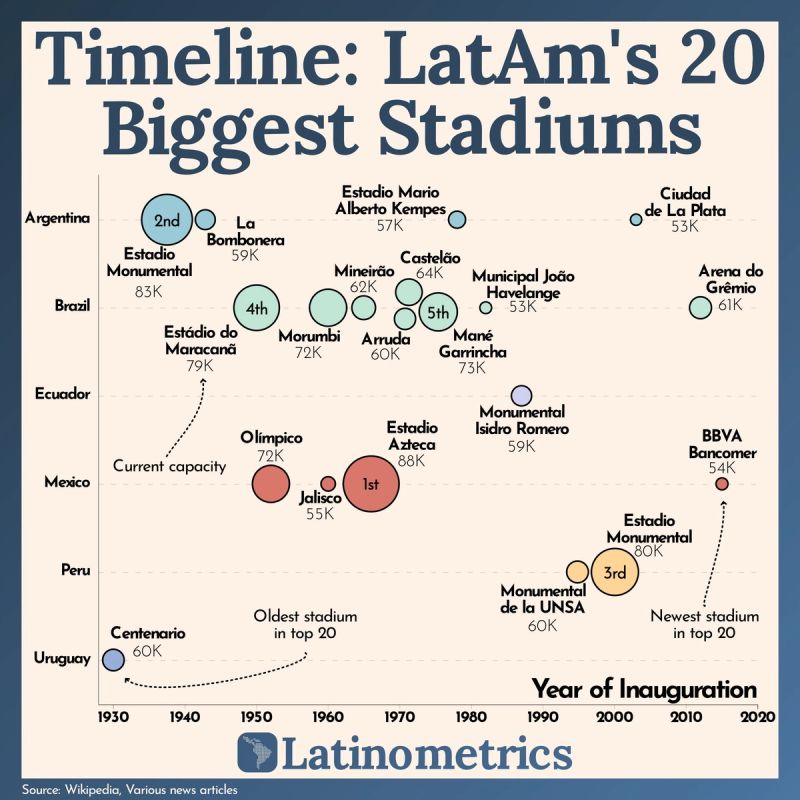
Are Latin American stadiums shrinking in size?
It appears so. The largest stadiums in the region, built in the past, are being succeeded by newer, smaller ones — only two of the ten largest stadiums were built in the 21st century.
Why is this the case? We could find no studies on the topic, but we do have a hypothesis.
Since all these are soccer stadiums, they're intrinsically tied to the game's history. Soccer started gaining popularity across the world throughout the 20th century, and Uruguay's Estadio Centenario in 1930 hosted the first world cup — the oldest stadium on our list.
As the sport and the world cup gained global popularity, Latin American teams (just the usual 3) won championships, and, with that, the region gained notoriety and the privilege to host.
This privilege brought the need for countries, in collaboration with private initiatives, to build infrastructure (aka huge stadiums) around "the beautiful game." A golden era in stadium building came to the region, whose heritage still stands in the form of iconic stadiums such as Monumental in Argentina, Maracana in Brazil, and — the largest of them all — Estadio Azteca in Mexico.
As the sport's in-person attendance growth reached a plateau in the latter part of the 20th century, partly thanks to mass video streaming, the need for colossal stadiums was no more. Massive infrastructure was already in place, and there was no need for a country to build more than one 80K+ capacity stadium, right?
Therefore, new stadiums have less capacity but are more geared towards a pleasant visitor experience than old stadiums, which were optimized to fit the maximum number of people. A clear example of this is BBVA Bancomer stadium in Monterrey, Mexico. Our list's youngest stadium offers 324 suites, two restaurants, a commercial area, and parking space for 3.5K cars.
While the focus of new and old stadiums differ, they provide a beautiful contrast between the modern and the historical, which we must learn to appreciate whenever we visit LatAm's impressive stadiums.


