
Visualizing Spain's trade with LatAm
From empire to economic partner: Spain’s shifting ties with Latin America

Three hundred years ago, Madrid was the capital of a global empire upon which the sun famously never set.
The Spanish Empire, spanning over 13M square kilometers at its greatest territorial extent at the turn of the nineteenth century, ruled over most of the Western Hemisphere and is responsible for the eventual linguistic dominance of castellano in the New World.
Even just a few months ago saw a breakdown in relations between the current Argentinian and Spanish governments over personal insults. Clearly, ties are more complicated today than they were a few decades ago.
Visualizing Spain's trade with LatAm
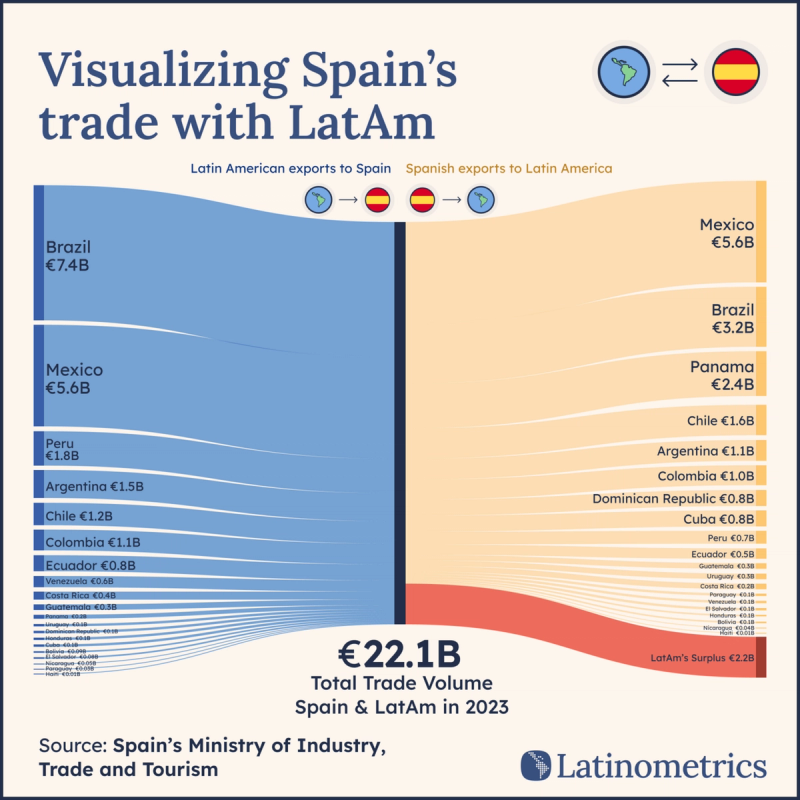
But while politics may leave much to be desired, economic relations are solid, driven by a 22B-euro trade volume.
Meanwhile, fuels and mineral oils dominate the exports of Latin America’s three largest countries – Brazil, Colombia, and Mexico – to Spain, reflecting the role played by the region in the Spanish energy matrix.
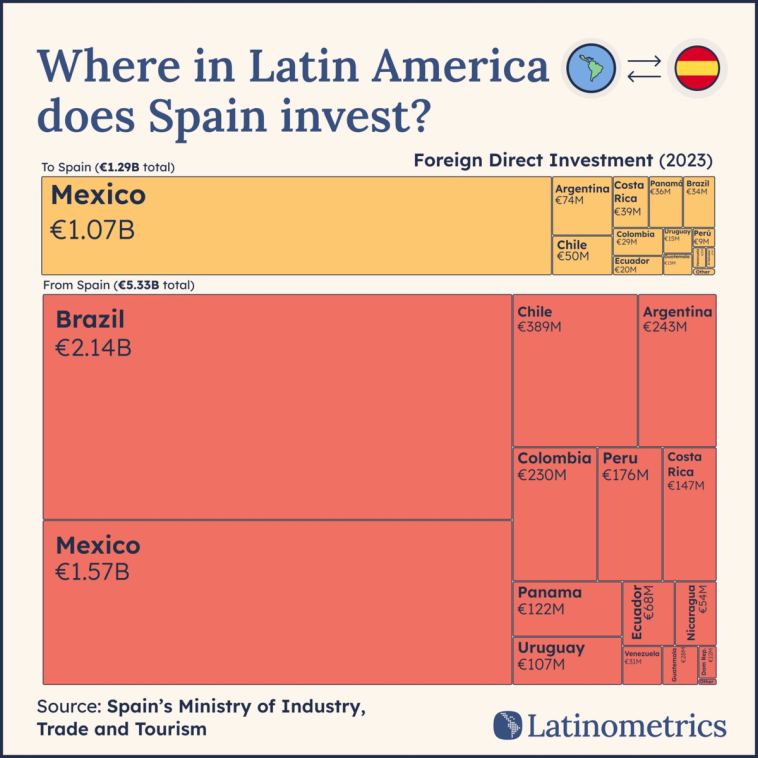
But while trade is important, it only tells half the story. Foreign direct investment (FDI) is where Spain truly shines and where the Iberian country serves as a doorway between Europe and Latin America.
Where in Latin America does Spain invest?
For decades now, and especially since the widespread wave of liberalization and privatization which occurred in 1990s Latin America, Spanish firms have been among the largest investors in the region.
Ranging from energy firms to banks such as Banco Santandar and BBVA, the Spanish position in the region is massive, including nearly 4B euro in just Brazil and Mexico. Interestingly, Brazil – not a former Spanish colony – holds more than half of this figure, representing the largest Spanish FDI stock in the region (though the trend does not hold true in the opposite direction).
Meanwhile, Mexican firms have over $1B of FDI stock in Spain, reflecting substantial interest in a growing European economy with less competition than, say, Germany or the United Kingdom. Given recent trends and the relative size of the two economies, we wholly expect Mexico’s total investment position in Spain to surpass the reverse in the coming years, symbolizing perhaps a final stage in the former colonial relationship.
From Spanish firms guiding the region’s energy transition to Latin American investors trying to turn Madrid into Miami, Spain’s contemporary relationship with its former colonies (and their neighbors) is complex and multifaceted. Two centuries after the decline of the Spanish Empire, though, business is booming more than ever.


