
Uruguay is LatAm’s Most Armed Country
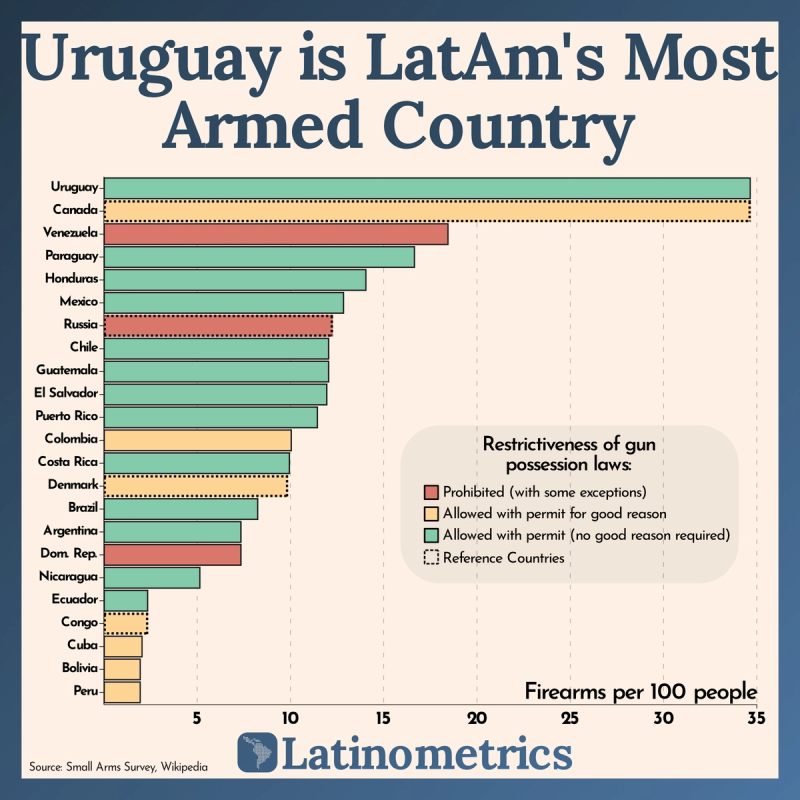
Uruguay out-arms Iraq with 35 guns per 100 people, but US gun laws fuel LatAm's violence.

A US-made gun is more likely to kill a Latin American than an American.
As the gun debate in America continues following another mass shooting, we decided to look at Latin American rates of firearms ownership.
Uruguay has the highest concentration of firearms in Latin America, with an estimated 35 civilian guns per 100 people. There are close to 1.2M firearms in the country of 3.5M, half of which are estimated to be illegal. Uruguay's gun ownership rate is higher than countries like Iraq (19 weapons per 100 people) and its neighbors Argentina (7.3) and Brazil (8.2)—but far from the United States, which has 120 guns per hundred citizens.
With more than 200K firearms trafficked every year from the US to Mexico, most of the guns on this chart were likely smuggled from the US; and The Economist reported that 70% of Mexican gun crimes involve weapons purchased in the United States. This fact highlights another vital topic not often addressed when discussing gun control in the US: the problem of gun violence in Latin America, a leading cause of death in the region. Of course, poverty, lack of opportunities, and gang culture contribute to high levels of gun crime in LatAm countries. However, to understand the issue of gun violence in LatAm, it is also essential to first consider that much of its origin can be traced back to guns smuggled into the region from the US.
The data on gun ownership in Latin America underscores the need for stricter gun control measures not just for the US, but also for the sake of its southern neighbors. Many gun enthusiasts don't believe that gun control will help save American lives — but they might recognize that stricter gun laws in the US could help decrease the flow of weapons to LatAm and consequently save lives south of the border. It's time for a hemispheric approach to tackling this problem.


