
Visualizing LatAm's 100+ Coups D'Etat Since 1900
Peru's 2022 self-coup attempt adds to LatAm's 100+ since 1900, with some nations seeing 8.

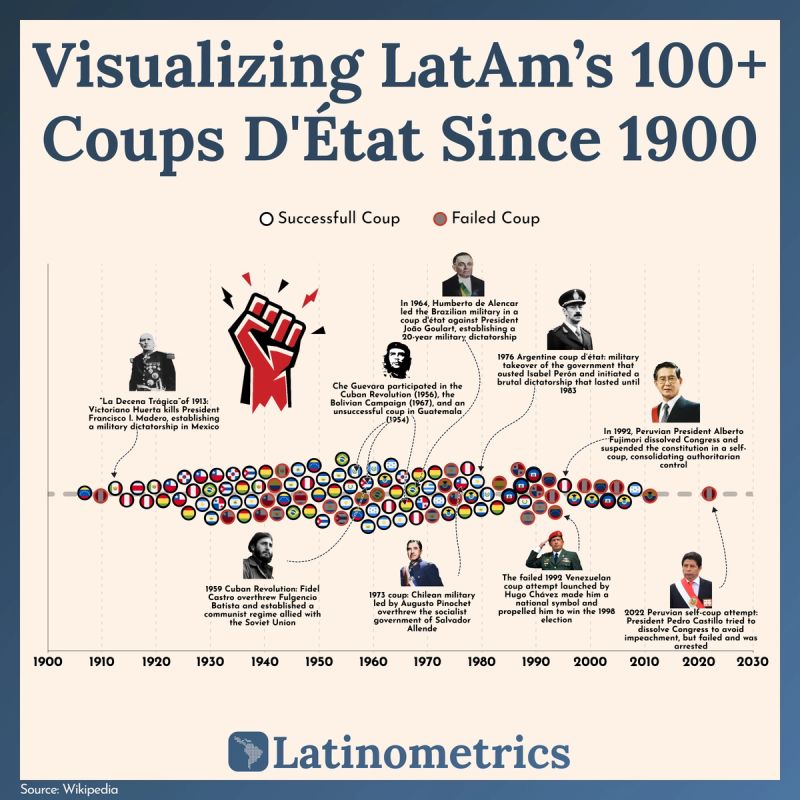
Last December, Peruvian President Pedro Castillo announced his dissolution of the country’s congress just as legislators were preparing to impeach him. The following few hours saw a political rollercoaster that ended with Castillo removed from office, delayed by Lima traffic, and arrested as he attempted to flee to Mexico. The whole incident was referred to in both Peru and abroad as an attempted autogolpe, or “self-coup,” where a leader consolidates control by suspending the constitution or another branch of government.
This may have been the first attempted coup état of the 2020s, but it’s far from the first one in Peruvian history. In fact, Castillo’s model could well have been former President Alberto Fujimori, who pulled off a (successful) self-coup over 30 years ago in 1991.
And Peru’s far from alone in having its modern history marked by violent seizures of power. Most Latin American countries spent the 20th century grappling with multiple coup d’états, with some even seeing back-to-back ones as different political and military factions fought for control. Argentina witnessed 6 coups throughout the century; Chile suffered 8.
Global instability has something to do with this, of course. Coups have an old relationship with social and economic discontent, and crises faced by countries such as Argentina and Peru certainly factored into the various government overthrows each country saw throughout the 1900s. International politics also played a major role, as many of the most famous and destructive coups—such as in Mexico in 1913, Brazil in 1964, or Chile in 1973—were backed by foreign governments such as the United States.
Often, coup leaders were themselves later toppled in similar circumstances. Fulgencio Batista, for example, seized power in 1952 and was deposed just 7 years later by Che Guevara and the Castro brothers in the Cuban Revolution that installed a regime which still exists to this day. Alfredo Stroessner, the Paraguayan dictator who was removed in the 1989 coup d’état that led to democratization? He himself overthrew the president with the help of the military just 35 years earlier. Violence certainly begets violence in Latin America—leaders who live by the sword often die by it too.
Much has been said in recent years about the wave of popular discontent that has led to 17 different incumbent governments losing elections since 2018, from Mexico down to Argentina. But while people’s dissatisfaction is understandable given the region’s economic woes as of late, it’s worth noting that electoral defeat is precisely how governments should change. The first 150 years of independence saw every Latin American country torn from one violent seizure of power to another, with dictatorships to follow and lives lost every single time.
If today the most leaders have to fear is being voted out of office? Then the region, the developing world’s most democratic, has indeed come a long way.


