
LatAm leads in women’s political inclusion
Latin America has more women in national legislatures than any other region worldwide. Surprised?

In October, Claudia Sheinbaum made history as the first woman to ever assume Mexico’s presidency, a landmark moment in a country which only passed women’s suffrage in 1947 and which still deeply struggles with gender equality. Over half a year in, Sheinbaum’s approval ratings hover around 80%, making her perhaps the most popular democratic politician on the planet.
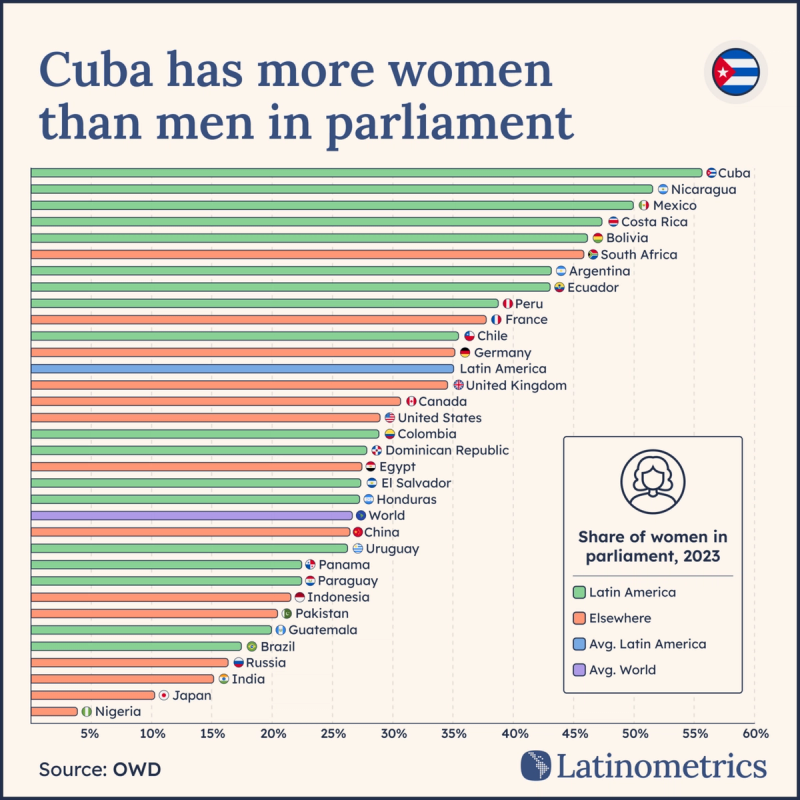
But when la Presidenta looks to her country’s politics, she may also be encouraged to see that precisely half of the Mexican legislature consists of women—making the country one of just five globally where this is the case.
Now, a caveat: this is no accident. It’s mandated by laws passed since 2014 which have required gender parity in both candidates put forward for elected office and elected officials.
Cuba has more women than men in parliament
And then, there’s Cuba, which with a share of 55% women in parliament is second worldwide (behind only the small Central African country of Rwanda). Cuba lacks the legal mandates of many of its Latin American peers.
Instead, as a one-party state, the country’s legislature is informed in part by a multi-stakeholder Candidacy Commission, which will allow different interest groups to advocate for their interests. Some of these, such as the Federation of Cuban Women, help to propel women into the political sphere.
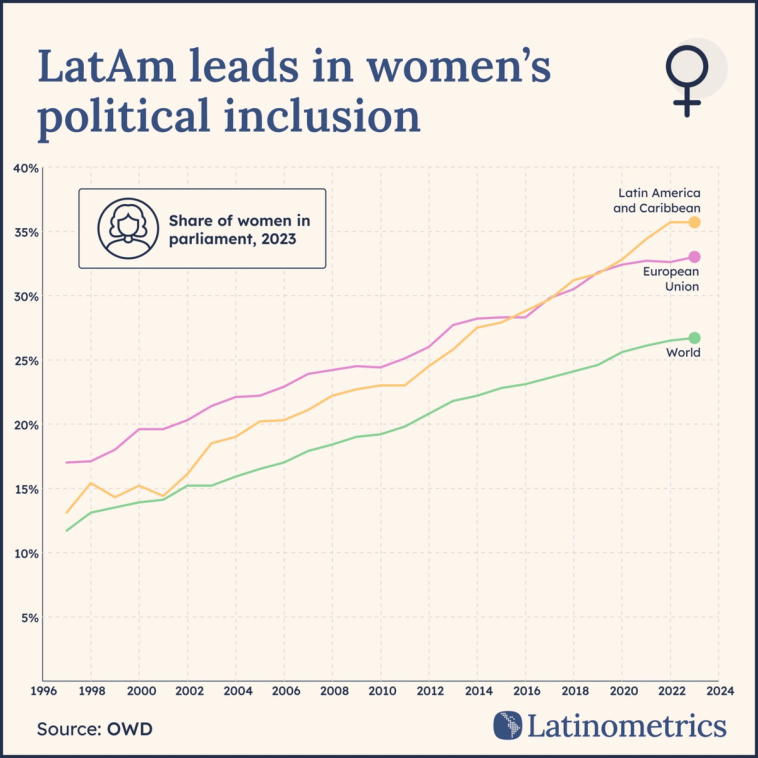
With this Cuban system taken alongside legal mandates and quotas, even in lower-ranked countries like Brazil, Latin America’s regional average of 35% is the highest worldwide. This not only tops the global average, it even beats highly-developed regions like the European Union. That thirty years ago the reverse was true makes this all the more impressive.
With three sitting female presidents – Sheinbaum, but also Xiomara Castro of Honduras and Dina Boluarte of Peru – as well as persistently higher numbers of female candidates for national legislatures, women are moving up in Latin America’s political sphere.


