
9 in 10 of Peru's migrants are Venezuelan
Peru is home to nearly 1.9M immigrants, most of them Venezuelan, even as Peruvians themselves emigrate to the US, Spain, and Chile.

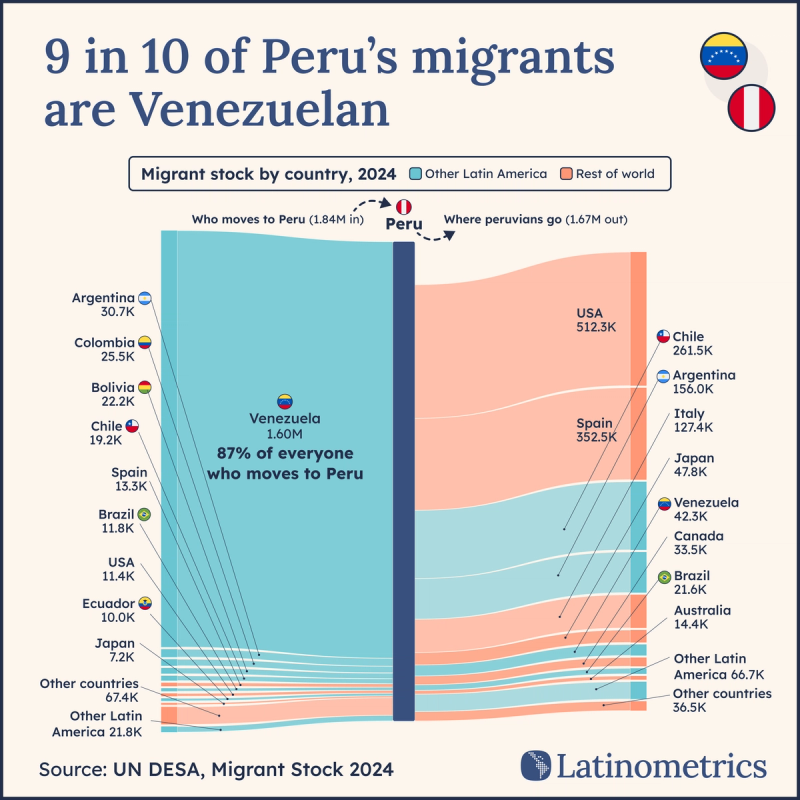
When people hear migration, they often think of people heading north to destinations in Europe or the United States. Peru provides a relevant counterexample.
The total number of immigrants in Peru now exceeds the total number of Peruvians living abroad. Standing out as the largest group of migrants, Venezuelans make up over 85% of the nearly 1.9M migrants in the country. In fact, there are almost as many Venezuelans in Peru as there are Peruvians abroad.
Historically more of a migrant source, Peru began receiving a larger influx of migrants in the late 2000s as it became increasingly attractive in economic terms for people from other countries.
At first, many immigrants were male adults originally from places like Argentina, China, and the United States. But the composition and profile changed dramatically in the 2010s as nearby Venezuela slid further into economic and political crisis following the death of Hugo Chávez and Nicolás Maduro's rise to power.
Peru's New Immigrant Population
As hyperinflation, diminished job opportunities, and a worsening political landscape pushed more Venezuelans to flee, Peru initially responded with innovative migration regulations to manage the accelerating influx.
In 2017, the government introduced a Temporary Stay Permit (PTP), later replaced by the Temporary Stay Permit Card in 2023. Instruments like these helped to facilitate the regularization of Venezuelans in the country and provide a more effective integration pathway into Peruvian society and economy.
Peru nevertheless took steps to constrain further immigration as numbers continued to rise. The Andean country limited the PTP to Venezuelans who had entered the country by the end of 2018 and began requiring newly-arriving Venezuelans to present a passport and visa for the first time.
Since then, different measures have oscillated between expanding protections and restricting access.
Despite the availability of temporary protection systems, almost 60% of registered immigrants in Peru still did not hold a valid migration permit by late 2022. In most cases, no permit means no labor protections and no formal employment.
The Peruvians Who Leave
If Venezuelans have headed to Peru to escape the politico-economic crisis back home, Peruvians have their own reasons for going abroad.
Driven primarily by labor-market frustrations and professional bottlenecks, many Peruvians leave as a result of chronic structural challenges. Many wind up where you might expect, in Spain or the US, but a notable portion also remains within Latin America.
Nearly three-quarters of Peru's workers currently work informally, in line with regional trends. At the youth level, this figure rises to 87%, higher than every other Latin American country besides Bolivia, Guatemala, and Honduras.
Limited quality vocational training and a mismatch between education programs and employers' needs have kept many workers out of the formal labor and pension system, which hurts both the worker and the country.
Peru's informal labor market can create openings for migrant workers without regularized status to earn a living. Yet, these same economic conditions, combined with ever more unstable political institutions and growing crime rates, are also driving many young Peruvians to consider emigration.
Peru's democratic crisis continues, while Venezuela is entering a fragile new political chapter under interim president Delcy Rodríguez. How these governmental shifts will impact migration to and from Peru remains to be seen.
| # | Living in Peru (origin) | People | Share | Peruvians abroad (destination) | People | Share |
|---|---|---|---|---|---|---|
| 1 | Venezuela | 1.60M | 87% | United States | 512K | 31% |
| 2 | Argentina | 31K | 2% | Spain | 352K | 21% |
| 3 | Colombia | 25K | 1% | Chile | 262K | 16% |
| 4 | Bolivia | 22K | 1% | Argentina | 156K | 9% |
| 5 | Chile | 19K | 1% | Italy | 127K | 8% |
| 6 | Spain | 13K | <1% | Japan | 48K | 3% |
| 7 | Brazil | 12K | <1% | Venezuela | 42K | 3% |
| 8 | United States | 11K | <1% | Canada | 34K | 2% |
| 9 | Ecuador | 10K | <1% | Brazil | 22K | 1% |
| 10 | Japan | 7K | <1% | Australia | 14K | <1% |
Source: UN DESA, International Migrant Stock 2024. Shares are of each flow's total (including smaller origins/destinations not shown).


