
Latin America punishes whoever holds power
Why has Latin America's political opposition won 76% of elections since 2017, no matter who's in power?

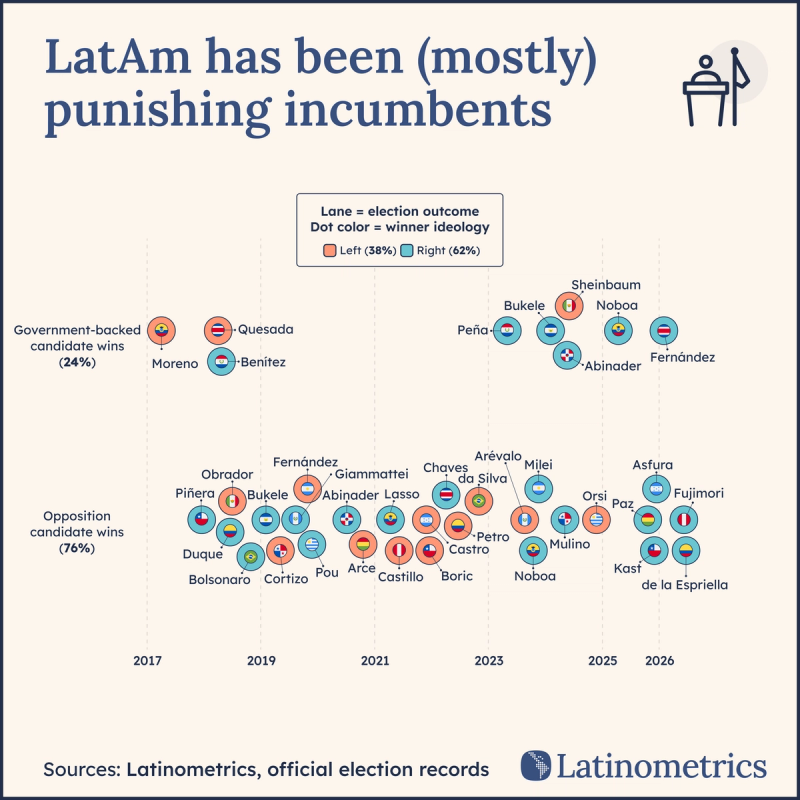
Over the last decade, Latin America has frequently been characterized as a politically bipolar region. The mornings after presidential elections typically highlight either a Pink Tide as left-wing politicians rise or a Blue Tide as right-wing leaders take over.
Beyond the differences in ideological labels, however, a deeper pattern is revealed if you scratch under the surface. The constant left-right pendulum swings don't necessarily stem from Latin American voters falling in love with one side over another; rather, they reflect a systematic punishment of whoever currently holds power.
Over the last 10 years, the political opposition (left or right, doesn't matter) has won 76% of all free and fair elections in Latin America. In other words: these are tough times to be an incumbent government.
The One-Percent Verdict
Most recently, Colombia joined the club with President-Elect Abelardo de la Espriella, a right wing criminal defense lawyer who has sworn to rebuild Colombia's institutions, economy, and public security. The 47-year-old political outsider is expected to impose mano dura policies with the aim of achieving national stability.
In the runoff on June 21, De la Espriella secured 49.66% of the vote against Iván Cepeda, an ally of the outgoing administration — the narrowest margin in Colombian election history.
Out of nearly 26M ballots cast, a narrow margin of just one percent (251K votes) reversed the country's executive direction. The incumbent government is out of time to manage Colombia's substantial challenges.
A Region-Wide Domino Effect
Colombia is far from an outlier. Conservative candidates have particularly benefited from the anti-incumbency train since 2020.
In November 2023, Javier Milei became a notable pillar of this regional rightward shift, which was subsequently followed by José Raúl Mulino in Panama and Daniel Noboa in Ecuador the following year. The pattern persisted in 2025 as Rodrigo Paz broke decades of socialist rule in Bolivia, José Antonio Kast claimed Chile for conservatism, and Nasry Asfura toppled Honduras' incumbent Libre government.
This wave shows no sign of abating. Costa Rica is currently represented by the conservative Laura Fernández, while right-wing politician Keiko Fujimori is the presumptive president-elect of Peru.
The Political Pendulum
People across Latin America are experiencing economic anxiety and a lack of public safety, which has translated into voting for increasingly extreme candidates out of pure desperation. In Argentina and El Salvador, this desperation led to Javier Milei's mass austerity measures and Nayib Bukele's mega-prisons. In Colombia, it empowered a political outsider by treating tough-on-crime security as a non-negotiable priority.
Ultimately, the political pendulum will continue to swing as long as core constraints remain unchanged. Colombia's new administration will have to deal with the exact same high-interest debt loads and structural security voids which destabilized the previous government.
Today's voters rarely grant second chances. If new governments cannot deliver tangible safety and economic stability, it won't be long before the next election cycle punishes the new palace holders as well.
Source: National electoral authorities, 2017–2026


