
Low rates created Brazil's investors, and they stayed
After Brazil's Selic rate fell to 2.89% in 2020, B3 retail stock investors exploded to 1.6 million and held even as interest rates returned to 14%.

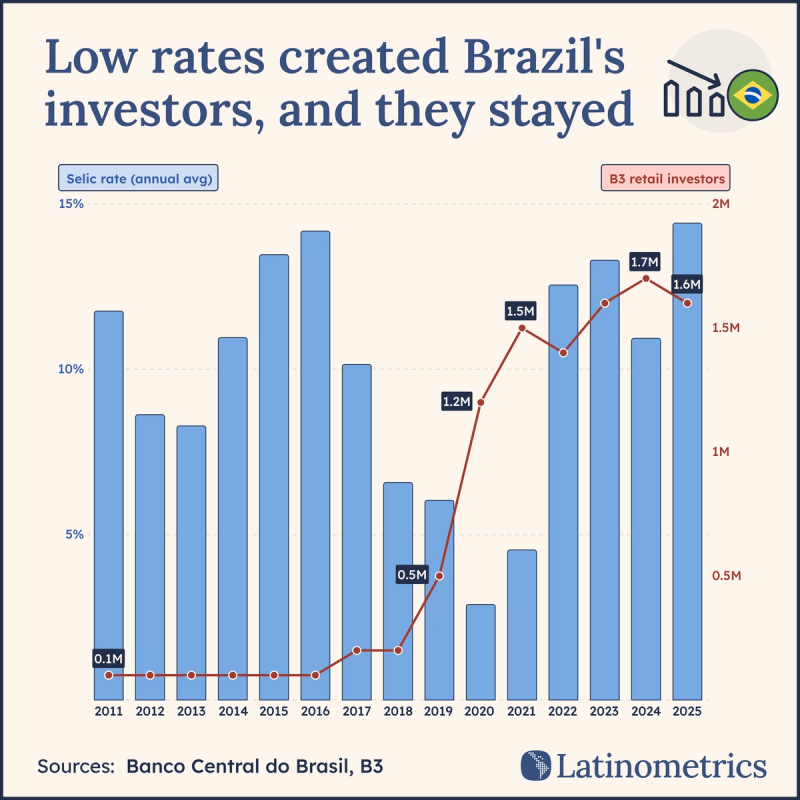
The boom was built on a single number. Through most of the 2010s, Brazil's retail equity base barely existed, flat at 100-200K investors while the national Selic interest rate sat in the high single and double digits. Why invest in stocks when fixed income paid you handsomely to do nothing?
Then the floor fell out when, in 2020, the policy rate averaged 2.89%, the lowest level Brazil had ever recorded. Rates that low, far below anything Brazilians were used to, pushed millions toward investment alternatives they had never bothered to consider.
The response was staggering: in roughly two years, the retail base of the B3 (Brazil's main stock exchange) soared by 15×, from 100K to 1.5M Brazilians holding stocks, funds, or ETFs, many for the first time. Cheap money all but manufactured a new investor class.
When the Selic climbed back into double digits from 2022 on to keep inflation from spiking, the textbook says those investors should have fled back to fixed income and the base should have shrunk. Instead, though, the count plateaued at 1.6–1.7M.
Which makes sense; after all, once a brokerage account is open and investing is as easy as sending a Pix, high rates don't make you close everything down and pull your money out of the markets. The new retail base was rate-built, not rate-bound.
What higher rates did kill, though, was the growth. As the tailwind reversed, the new investor base stopped expanding, as people's risk appetite shifted elsewhere. Some even turned to betting apps.
During the pandemic, Brazil built a generation of investors at a two-percent interest rate. The harder question is what keeps them invested now that that rate looks closer to 15%.
Source: Banco Central do Brasil (SGS 432); B3 Pessoa Física reports


