
50 Years of Progress: Infant Mortality Reduction in LatAm
A look at progress in one of the world's most crucial metrics.

With all of the partisan gridlock and political retribution in Latin America nowadays, it can be easy to feel like the region is irreversibly polarized—that every issue, every fight, is one for the culture war.
However, that’s not necessarily the case. Semi-normalcy has returned to Brazil for now. The candidates in this year’s Uruguayan election have so far remained mostly focused on policy disagreements rather than launching threats of prosecution against their opponents. Javier Milei even met with the Pope, who he once accused of being an “imbecile” who promotes communism, and the meeting apparently went quite well.
And if there’s some promising signs of political and social stability here and there, it’s worth recalling the many important issues upon which we can all agree. Like healthy babies, for example.
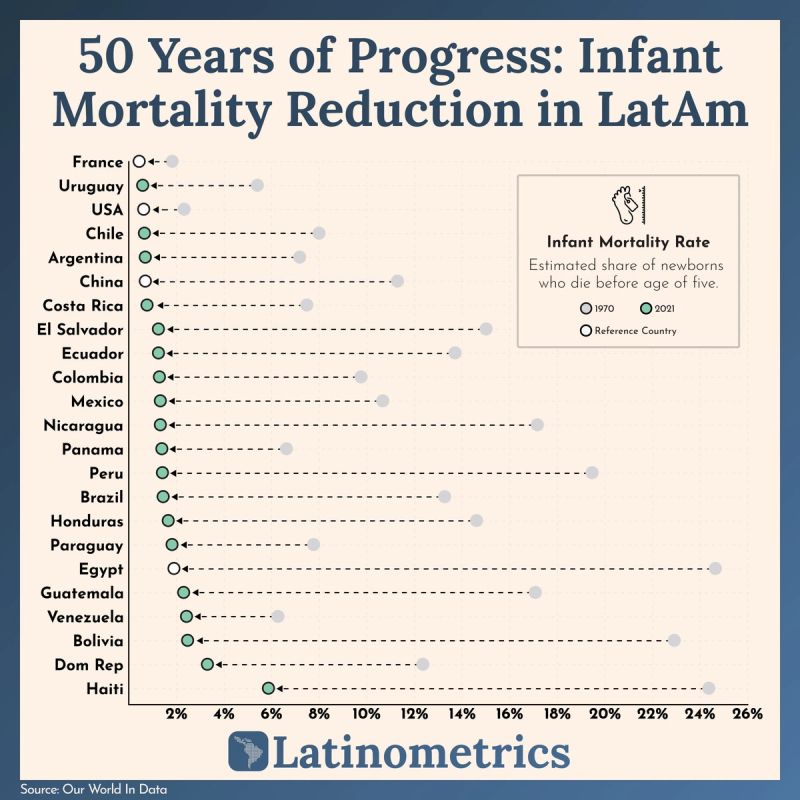
In the last half-century, infant mortality has plummeted across Latin America.
Infant mortality measures the percentage of newborn babies who pass away before reaching the age of five.
A number of factors play into this metric, such as healthcare access, hunger situation, and violence levels in a country. Young kids can pass away early on due to everything from malnutrition to war to infectious diseases which target them while their immune system is still weak.
As Latin America has developed, it’s seen 50 years of infant mortality rates descending, something also seen around the world in countries which have grown more prosperous and (sometimes) less unequal.
Today infant mortality is low – less than a percent, equal to highly-developed countries like France – across Latin America’s biggest success stories, whether that be Uruguay, Chile, Argentina, or Costa Rica.
However, it’s not these countries which have seen the most significant jumps. For this, you’d need to look south to Peru, which at the beginning of the 1970s saw roughly 1 out of every 5 newborns dead by their fifth birthday.
In comparison, in 2021 Peru’s infant mortality rate stood at just under 2%, meaning a roughly 90% drop in just 50 years.
While every country in the region has made progress on this important metric, one does stand out as an outlier. Haiti’s infant mortality rate hovered around 6% in 2021, triple that of all of its Latin American peers.
The country’s persistent chaos and underdevelopment has severely hurt its most vulnerable citizens, babies. And while there’s been progress over the last century, the current crisis gripping the country since 2021 is likely to only further set back efforts to raise standards of living and save more lives.
While it’s easy to get drawn into the daily political theater and turbulence of Latin America’s up-and-downs, it’s important to never lose sight of big changes. Today fewer newborns are dying around the region than ever before—but there remains much work to be done.
We always love a very out-of-the-box chart idea. In this case: Antarctican scientific bases. Who would’ve thought?


