
What produces LatAm's greenhouse gases?
Exploring Latin America's dual role as climate change victim and contributor to global emissions.

Last week, we provided an overview of surface temperatures across Latin America, in the process showing that many disparate crises in the region – from droughts and water insecurity to Brazilian forest fires – were tied to changing climate conditions.
Now, it’s worth recalling that most excess pollution happens (or has happened) in the developed world, particularly the United States, European Union, Japan, and Russia. Other developing regions, in particular East and South Asia, also play a significant role in emitting the greenhouse gases (like carbon dioxide or methane) which trap heat in the Earth’s atmosphere and exacerbate climate change.
But don’t think that Latin America is merely subject to the impacts of climate change. Across the region, countries are also emitting greenhouse gases (GHGs), with certain industries in particular driving emissions.
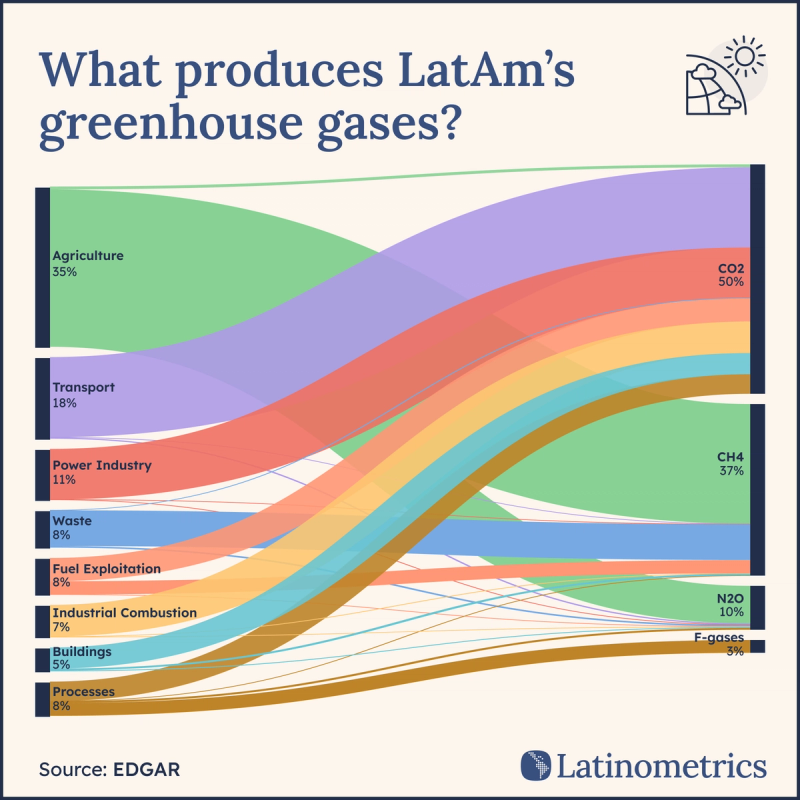
Agriculture is by far the largest source of GHG emissions in Latin America, making up over a third (35%) of the total. In a way, this isn’t too surprising, especially given the essential role played by regional farming in both the local economy and global food supply chains. Agriculture and transport alone make up half of all emissions.
But agriculture can also be a particularly high-emitting sector. Take soy, long a top crop for the much of the region, making up over 10% of both Argentine and Brazilian exports and nearly 30% of Paraguayan exports, in 2023. International researchers have tracked for years the high carbon footprint associated with Brazilian soy, examining not only the export process but also the deforestation and land-use change associated with the crop’s production.
And if soy is bad for the environment, beef is even worse, not least due to the high amounts of soy needed to feed cattle. No wonder, then, that Uruguay is the top per-capita emitter in Latin America, ahead of even meat-exporting heavyweights like neighboring Argentina and Brazil.
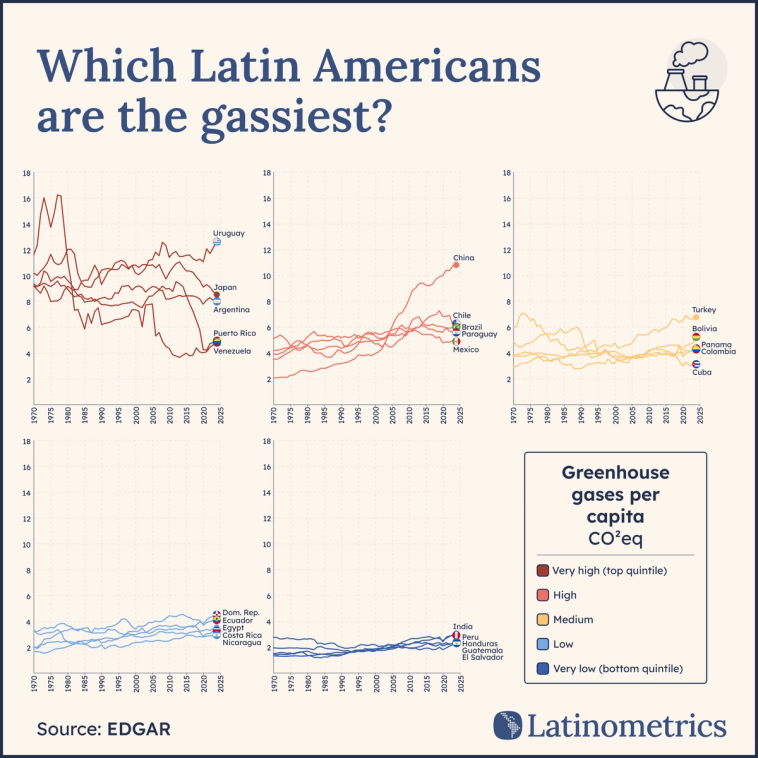
Of course, agriculture is not the only culprit of rising emissions in the region. Oil production and industrialization play their own roles in pollution, which explains the relatively high emissions for Mexico and especially Venezuela.
On the flip side, smaller and relatively underdeveloped economies, such as in Peru or much of Central America, tend to have less in the way of a carbon footprint. Green superstar Costa Rica of course occupies a solid role among the smallest emitters.
All in all, the transport, industrial, energy, and especially agricultural sectors mean that Latin America has more agency in shaping global emissions than many think. With COP30 set to be held in northern Brazil in just a few short weeks, Latin American leaders can help shape the dialogue in reducing emissions—and in the process try to stall some of the damage their environments are facing.


