
How Fast Has LatAm's Population Grown in 70 Years?
LatAm's population quadrupled in 70 years, but Uruguay's growth mirrored Europe, even dropping in 2021.


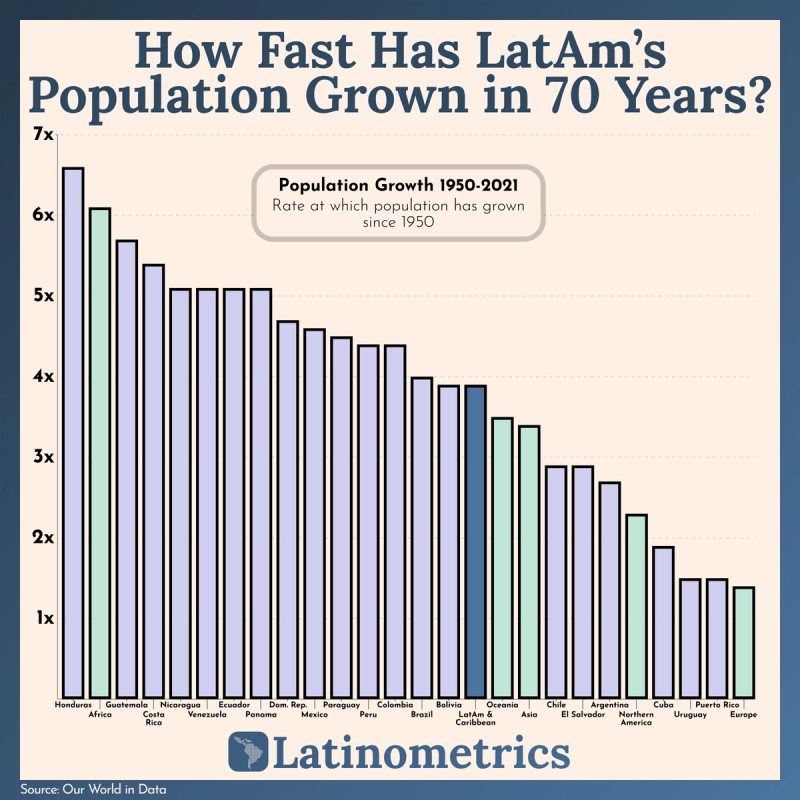
As a whole, Latin America & the Caribbean has quadrupled in size since the mid-20th century, adding around 500M people in just three generations. Population growth in the region has been higher at various points in recent history than almost anywhere else in the world, particularly in the emerging metropolises that dot the hemisphere.
However, the population boom has not been evenly spread. Honduras and its Central American neighbors of Costa Rica, Guatemala, and Nicaragua have each seen growth of 5-8x since 1950. On the flip side, growth rates in Uruguay and Puerto Rico have been more comparable to industrialized European countries.
What’s to explain these divergent trends? Well, a few factors. Migration flows, meaning whether more migrants are moving into or leaving an area, can be significant, as seen in Puerto Rico since 2005. General birth and death rates, affected by infant mortality and living standards, can also play a role, as well as religious factors, medical advances, and nutritional status.
So it’s not a coincidence that Latin America’s least unequal and most developed country, Uruguay, actually saw its population drop in 2021. Universal healthcare and education have certainly helped.
However, lower population growth comes with its own challenges. Population decline means aging populations and an increased pressure on state pension systems. Not to mention, regions tend to grow less once they have developed, and yet Latin America’s population slowdown has accompanied another lost decade for economic growth. Germany and Japan can afford to have stagnating birthrates, sure, but can Argentina and Colombia?
After all, at nearly 230M inhabitants the closest global comparison to Brazil in terms of population is Nigeria, which like Brazil is the largest country on its continent and region. Yet Nigeria’s population grew by 3x more than Brazil’s last year, while the country’s average age is half that of Brazil. Increasingly, the two giants are telling very different economic stories.
In sum, the last few decades brought a population boom to Latin America. What will the next few bring?


