
LatAm's Wide Gender Gap in World Cup Performance
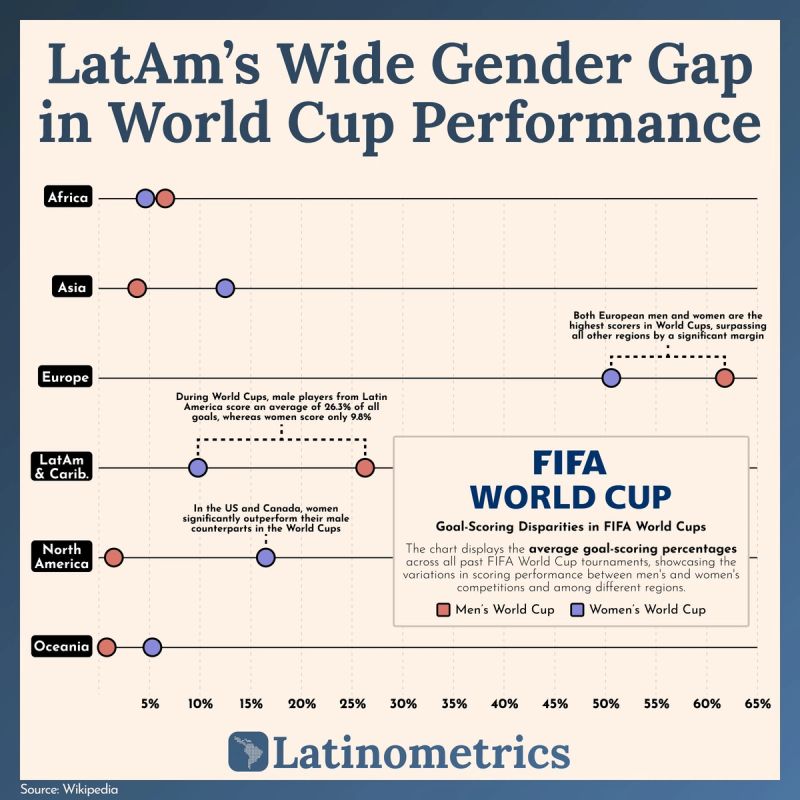
LatAm's wide gap in World Cup scoring is bigger than any other region globally.


Just over two weeks ago, the 2023 FIFA Women’s World Cup wrapped up in Sydney, Australia. While the victory by Spain’s national team was well-deserved, we won’t lie: we were rooting for a Latin American team to bring home the gold.
We would’ve loved to see Brazil clinch victory, particularly as this was the end of the World Cup road for Marta, widely regarded as the greatest female player in history. We also passionately followed Colombia, whose squad made it all the way to the quarter-finals this year, well ahead of its regional peers.
Seeing how well Las Cafeteras did inspired us to look at gender parity throughout the world of association football. Specifically, we were curious how men and women stack up in terms of the total amount of goals scored in their respective World Cup tournaments.
And the answer is: it sort of varies based on the region.
Latin America’s male players have scored over a quarter of all World Cup goals, while the female players just less than a tenth. This gap in scoring is larger than any other region worldwide, slightly edging out the reverse gap seen when it comes to scoring in the United States and Canada.
These North American countries, alongside both Asia and Oceania, see women outscoring their male counterparts on the pitch. While all three regions have never seen their male teams even make it to the finals, both the Japanese and US women’s teams have won the tournament—the latter on multiple occasions.
Without a doubt, European players continue to dominate the Beautiful Game. Both male and female players from the continent have scored a majority of all goals in past FIFA World Cups. Europeans’ passion for the sport, as well as heftier budgets, have helped propel their players to the top.
Even if the Argentinean women’s Albiceleste didn’t bring home the gold like their male counterparts did last December, or Marta didn’t bring Brazil back to the World Cup finals like in years past, we’re proud of all the Latin American teams who played in the Women’s World Cup.
In the years to come, we know that we’ll see both gaps – between men and women, as well as between Latin America and Europe – shrink. And we’ll be cheering from the stands as always.


