
🇺🇸 Latino GDP
The world's largest economy relies on Latinos contributing to everything from Finance & Insurance to Construction.

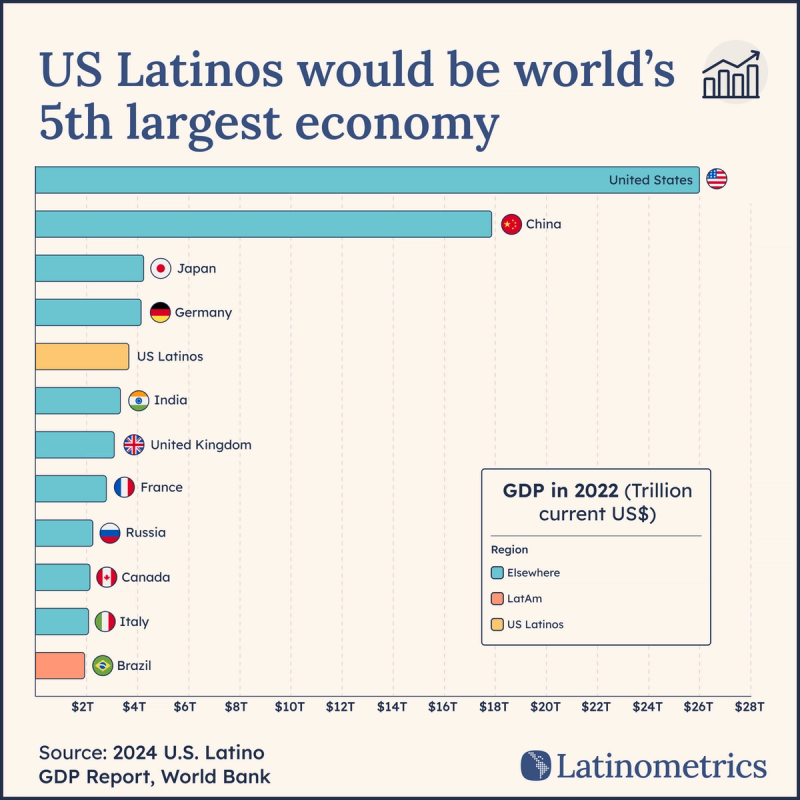
Last April, Brazil reentered the coveted top-ten list of the world's largest economies, some years after having fallen out due to economic crisis and stagnation. Today Brazil remains Latin America's largest economy by gross domestic product (GDP), but it trails a related demographic group — the Latin American diaspora living in the United States.
With nearly $4T in economic output, US Latinos fall behind only Japan, Germany, China, and (of course) the United States overall. Otherwise, they outperform every other country despite numbering just 65M people in total.
Impressive, no? Especially given lower-ranked countries – Brazil, yes, but also India, Indonesia, and Russia – number in the hundreds of millions and sometimes even billions of people.
Over six out of ten Hispanics in the US come from Mexico, while Colombians, Cubans, Dominicans, and Central Americans are also well represented. They are concentrated especially in the southwestern border states, Florida, and New York, and in some states – such as California and Texas – now make up a majority of the state population.
Lower taxes, sunnier weather, and growing business opportunities are prompting many Latinos to relocate from traditional hotspots like California or New York to Texas or non-traditional destinations like the Carolinas. But what drives this group's economic success?
Well, the sectors propelling Hispanic-American wealth aren't always the ones most dominated by Hispanics. For example, the largest sector contributing to the so-called Latino GDP is professional/business services, with roughly $475B earned in 2022, yet Latinos make up less than 15% of the sector's total figure.
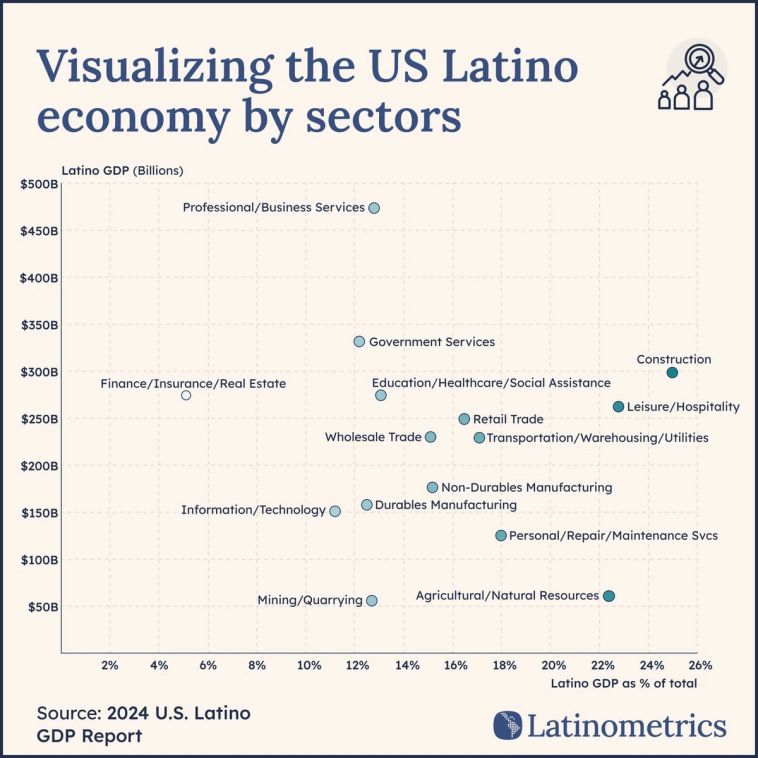
Contrast this with other sectors in the US, in which Latin Americans make up a far more substantial proportion. In construction, for example, Hispanics make up a quarter of total economic output despite this figure 'only' being about $300B. The smaller sectors of leisure/hospitality and especially agricultural/natural resources are almost as Latino-dominated.
No doubt, greater access to education and resources will only continue to propel the success of one of the US' fastest-growing minority populations. And if knowledge spillovers and inter-American tech transfer are to be believed, the hemisphere as a whole should stand to benefit in the process.
This week we’re accused of publishing “liberal imperialist propaganda” from our chart about democracy using The Economist’s index.


