
Pursuit of Longer Lives: Life Expectancy in Latin America
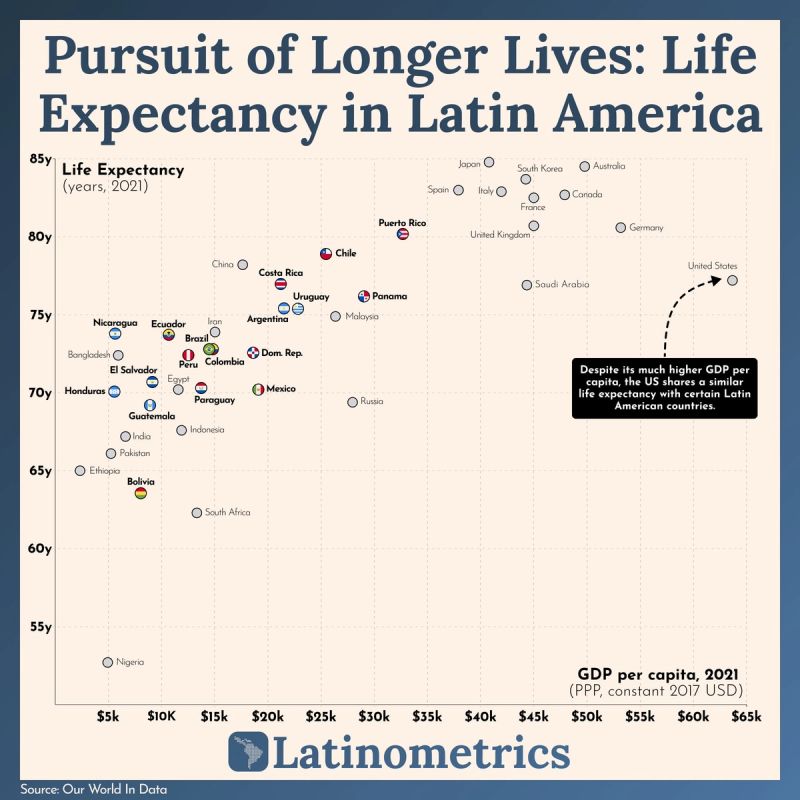
Chileans live 3 years longer than Americans, and Puerto Rico outlives all of LatAm.

The mixed bag of Latin Americans' longer lives
Fun fact: the average Chilean lives 3 years longer than their counterparts in the United States.
Shocked? You shouldn’t be. Chile has a notably strong mixed healthcare system which combines the public and private sectors to provide care to as many citizens as possible. Its homicide rate is also roughly a third smaller than that of the US, perhaps explaining why its life expectancy has been higher since the year 2000.
Despite having a far wealthier citizenry than its southern neighbors, the United States has an average life expectancy more akin to Costa Rica or Panama than fellow G7 members such as Germany or Japan.
This gets even more interesting when considering Puerto Rico. The small island dependency has an average life expectancy of 80 years, higher not only than the US but also the rest of Latin America. Be it due to diet, lifestyle, or its high share of medical and biotechnology manufacturing, this US territory has a citizen population far likelier to outlive all of its regional peers.
Of course, it’s not all rosy, and in most cases there’s a positive correlation between gross domestic product (GDP) per capita and life expectancy. Brazil, Colombia, and the Dominican Republic all see comparatively higher life expectancies than their peers in Paraguay or the Northern Triangle, for example, something to be expected given average income and inequality levels.
Certain outliers are otherwise impacted by high rates of violence and homicide, with Mexico emerging as the clearest example.
While the current situation is important, however, it’s also essential we look at how these countries’ positions have shifted in recent decades. For example, Nicaragua may be one of the poorest countries in the hemisphere, but since 1990 its life expectancy has increased by 11 years. For reference, even China — as the major economic story of this time period — didn’t see as impressive of a change.
Part of this, naturally, is a question of starting point. In 1990, while Costa Ricans were living on average longer than their European or US counterparts, most Nicaraguans didn’t even make it to the age of 60. As the country has attempted to overcome its severe underdevelopment and socioeconomic instability, it has seen significant progress even in the face of deepening authoritarianism and curtailed freedoms.
As our chart below demonstrates, for most of the region the past few decades have seen higher incomes and longer lives—though to varying degrees. While Latin America’s countries aren’t starting from the same place, through sociopolitical stability and greater safety nets for citizens the region can see its citizens live longer, more fruitful lives.


