
Nubank passed every private bank in Brazil
How a frustrated foreigner's account-opening problem became the fintech that overtook Bradesco, Itaú, Santander, and Banco do Brasil.

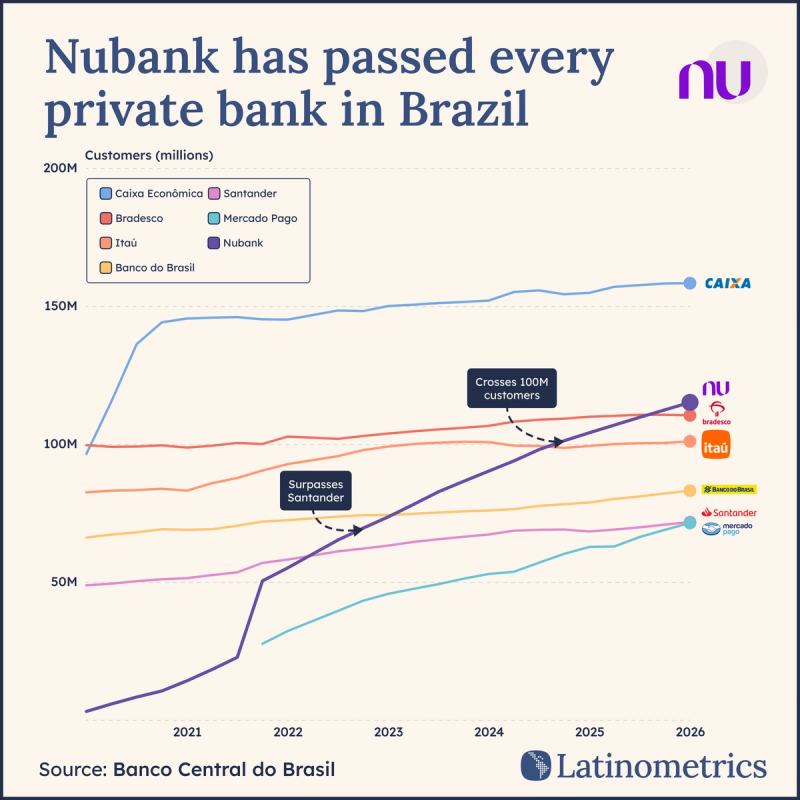
If disruption were a chart, the above would be it.
Nubank, the Brazilian fintech founded in 2013, is officially the largest private financial institution in the country. Caixa, the only financial institution with more customers as of 2026, is 100% government-owned, and was founded in 1861 as a national savings bank.
Every other bank in Brazil, Latin America's banking capital, today counts fewer clients. This includes not only privately-owned historic giants like Bradesco, Itaú Unibanco, and Santander Brasil, but also the state-controlled Banco do Brasil, which was famously founded by the King of Portugal in 1808.
Despite holding hundreds of billions in assets, these colossal banks have remained practically unmoved in terms of number of customers in recent years. Bradesco has roughly the same number of customers in 2026 as it had in 2020 during the pandemic.
Meanwhile, Nubank has added tens of millions of customers during that same time period, topping 100M Brazilian clients in November 2024. It surpassed Santander in 2022, Banco do Brasil in 2023, Itaú in 2024, and Bradesco in 2025. The purple revolution is officially here.
The Famed Origin Story
At this point, Nubank's origin story is almost as famous as Facebook's—and it involves a lot less betrayal than we know of.
Everything started with a Colombian, David Vélez, who was frustrated with how complicated and expensive it was opening a bank account as a foreigner in Brazil.
Along with co-founders Cristina Junqueira (Brazil) and Edward Wible (USA), Vélez brought a simpler form of banking to the country. As of 2026, over 60% of Brazil's adult population has a Nubank account.
The Purple Revolution Abroad
Nubank has not rested on its laurels in Brazil. Far from it: the company has added 15M customers in Mexico and 5M in Vélez's native Colombia, representing over 10% of the populations of each of those countries.
In the process of expanding within these countries, Nu is coming up against century-old banking giants much like they did in Brazil, including BBVA and Bancolombia.
Yet Nubank's meteoric displacement of Brazil's banks, the largest in all of Latin America, shows that the demand is there for sleek, innovative solutions to modernize banking. While the company is now looking north to enter the US market, we wouldn't be surprised to see near-future plans for other Latin American hubs like Argentina or Chile.
And back home in Brazil the company will need to keep an eye on the competition: not some 19th-century financial group, but fellow disrupter Mercado Pago, which has accelerated its own rise in recent years.
| Institution | 2020 | 2026 | Added since 2020 |
|---|---|---|---|
| Caixa (state-owned) | 96.3M | 158.2M | +61.9M |
| Nubank | new | 114.7M | — |
| Bradesco | 99.5M | 110.3M | +10.8M |
| Itaú | 82.4M | 100.9M | +18.5M |
| Banco do Brasil | 66.0M | 83.0M | +17.0M |
| Santander | 48.7M | 71.6M | +22.9M |
| Mercado Pago | new | 71.3M | — |
Source: Banco Central do Brasil (2026 Q1)


