
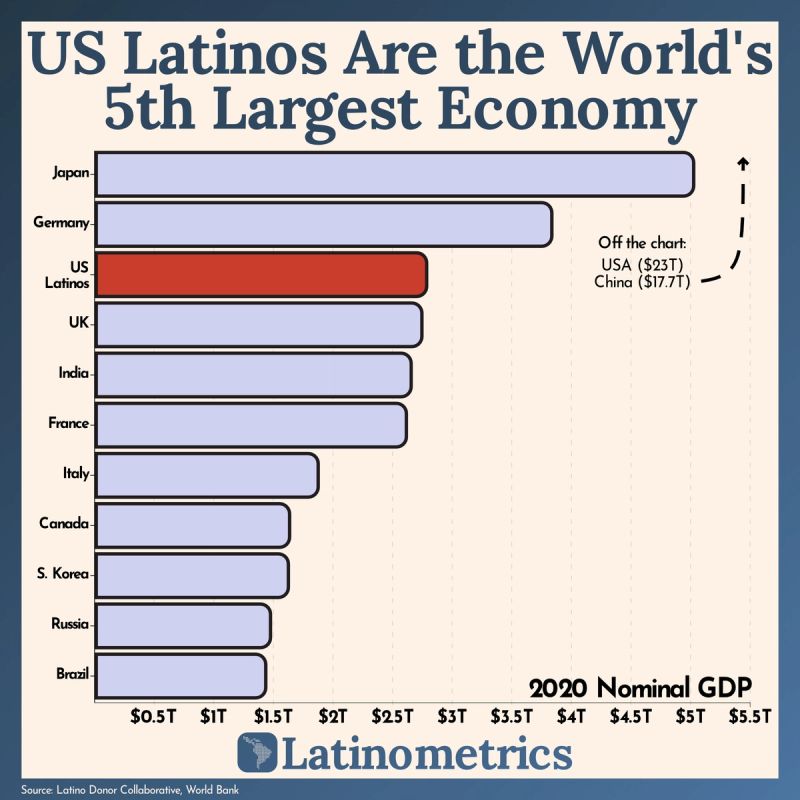
US Latinos Are the World's 5th Largest Economy
US Latinos would be the 5th largest economy globally, surpassing the UK and France.

From 1870 to 1950, just like the lovely architecture of Buenos Aires today, Argentina's economy looked much like that of a wealthy European country. Driven mainly by exports of livestock and raw materials and investment appetite from France and Great Britain, its GDP per capita at the end of this period was higher than Germany's, France's, and twice that of its former colonizer, Spain.
Argentina was once richer than Western Europe
No other Latin American country was remotely close to this level of economic development. Opportunity attracted a mass of (welcomed) European migrants, particularly from Italy and Spain, thus forever cementing their influence in Argentina's culture.
During the late 19th and early 20th centuries, European-commissioned buildings were erected all over Buenos Aires. From president Javier Milei's current office, La Casa Rosada (influenced by Italian architecture), to the second-to-none Teatro Colón (Belgian architect), to the majestic Palacio de Aguas Corrientes (Norwegian and Swedish architects).
Then there are the impressive embassies sprinkled throughout the city, which speak to Argentina's desire to hold strong foreign relations with world powers. But perhaps the most remarkable of all is France's embassy, the Palacio Ortiz Basualdo. Designed by French architect Paul Parter, this architectural masterpiece epitomizes the grandeur of the Belle Époque era.
Fortunes change, however; today, all three European countries on our chart have over double Argentina's GDP per capita. By this metric, Latin America's largest Hispanic country, Mexico, has now caught up to Argentina.
Nonetheless, and despite all the inflation issues we've all heard about, having an early start has paid off for Argentinian society. The country still ranks high (in the top 50) in the Human Development Index put together by the United Nations.
Human Development Index by the United Nations


