
Access to water remains achallenge in Latin America
Despite being water-rich, Mexico only grants 43% of its population safe drinking water; Puerto Rico and Chile show a path forward.

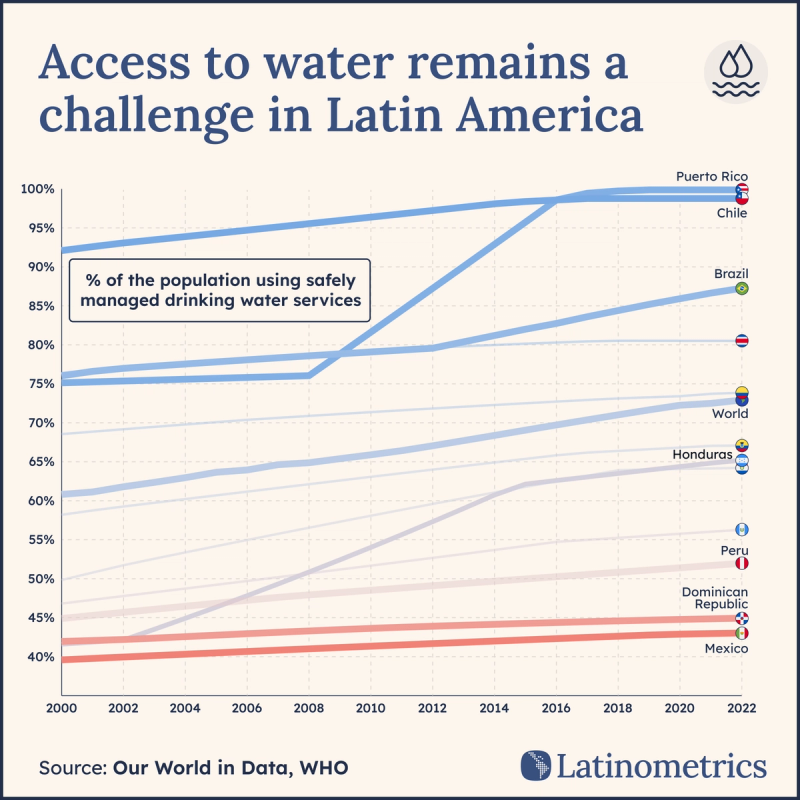
Challenges and solutions in Latin America's water scarcity.
As we enter a new record year of droughts and high temperatures, the most essential commodity for life on earth, which we often take for granted, has earned more of our attention.
Water scarcity, particularly access to safely managed drinking water, has been a persistent and pressing issue in Latin America. The irony at the same time is that Latin America is the most water-abundant region in the world.
Mexico, for instance, has grappled with a sanitation crisis for over two decades, with a mere 43% of its population having access to safely managed drinking water. This figure, nearly unchanged since the UN began tracking water accessibility, highlights the need for sustained and effective interventions.
As Mexico increasingly becomes one of the world's biggest economies, its population's most basic need, access to water, has been painfully neglected.
The country's aging pipe system leads to the loss of 35% of clean water due to poor distribution in some places. About 70% of lakes, rivers, and dams are polluted, posing availability issues and health risks. Frequent droughts, especially in the northern part of the country, worsen the problem.
The Dominican Republic also faces significant challenges in providing safe drinking water to its population, particularly in rural areas. Despite economic growth and a thriving tourism industry, many communities need help with water scarcity and contamination. Natural disasters, such as hurricanes and tropical storms, frequently damage water infrastructure and sewage systems, leading to widespread contamination.
But Puerto Rico, also in the Caribbean, proves that challenges are not impediments. Following Hurricane Maria, the US territory has achieved near-universal access to safe drinking water through recovery and modernization efforts supported by federal aid.
Honduras has also made significant progress this century, increasing its share of access to water from 42% to 65%.
Some startups like Aguardio, Waterplan, and Kilimo are driving innovation in water management by optimizing use across various sectors. By emulating successful models from Chile, Puerto Rico, and Honduras, the region could advance toward universal access to clean water, encouraging more private and public investment and sustainable practices.


