
How much do Latin America's banks lend?
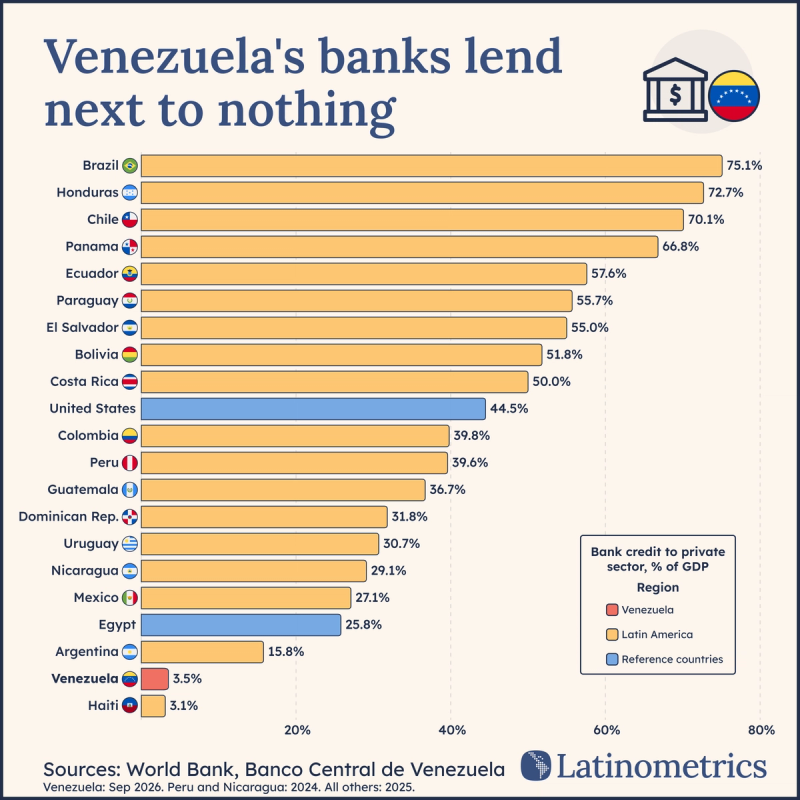
Bank credit to the private sector reaches 75.1% of GDP in Brazil and 44.5% in the United States. In Venezuela it is 3.5%, and that number was chosen.


Venezuela's credit system has an off switch, and someone just leaned on it again
Venezuelan banks learned this week that operating under the central bank's rules is about to get more expensive. The Central Bank of Venezuela (BCV) set escalating penalties for falling short on reserve requirements, and in a second resolution the same day raised the minimum rates banks must pay depositors while capping what they can charge borrowers at 12%. Both took effect on September 15, squeezing the margin from both ends.
In 2015, Venezuelan banks lent the private sector the equivalent of 23.9% of GDP, the last reading the World Bank published for the country. Today the figure is 3.5%, and roughly 85% of the country's financial depth has disappeared. Haiti, with a government barely in control of its own territory and hardly a banking system to speak of, sits at 3.1%.
The instinct is to file this under economic collapse, which Venezuela has no shortage of. But somebody sets the share of deposits banks must leave parked at the central bank, and that somebody is the BCV, whose board the president appoints and can remove. Money parked there can't go chasing dollars, which may be the point with the exchange rate under pressure. The credit market pays for it, and has for six years.
Since Maduro's capture in January, most readers have been waiting to see what the interim government under Delcy Rodríguez actually opens up. No financial liberalization has been announced, and Ecoanalítica does not expect a credit recovery before 2027. This week's resolutions tighten the screw further.
What the BCV does with everyone's deposits
Since 2022, the rule has worked like this: of every 100 bolívares a bank takes in at a branch window, 73 go straight to the central bank and 27 are left over to lend to anyone at all. It has a technical name, encaje legal, and that is the whole of it.
Nobody else does this. Colombia, one of the region's more active credit markets, lets its banks keep 93 of those 100, but its central bank has lowered that level twice since 2020 precisely to make credit cheaper. Brazil keeps 79. China, which is not known for a light hand on its banks, leaves them about 94. In the United States, the share banks have to hand over is zero, and has been since 2020. Mexico sets no percentage at all.
If 73 sounds crazy, consider that in April 2020 the BCV asked for 93, leaving banks 7 bolívares out of every 100. Banks can't hit even the softer number. By April 2024, universal banking had gone 40 straight weeks without parking enough money at the BCV, paying a fine every week for a rule it couldn't meet.
What does that look like on the ground? It looks like buying a kilo of ground beef through a buy-now-pay-later app. You fill a cart at a Caracas supermarket, reach the front of the line, pull out the credit card your bank issued you last month, and find the limit covers about that much meat. Nobody who lives there is surprised; there hasn't been real bank financing for years.
Nothing explains the drop the way a crisis would: no war, no wave of bank failures, no run on deposits. The whole system closed the first half of 2026 with a loan book of $3.9B, and the country's largest bank holds $950.6M of it, so roughly a quarter of all the credit in a national economy sits inside one institution.
The loan book is growing while the rules squeezing it get tighter. Venezuelan banks were lending about $2.4B in June 2025, and about $3.9B twelve months later. The squeeze never let up through any of it, and Delcy Rodríguez's interim government has not publicly explained why it stays on.
Who is lending instead
The phone that paid for the groceries is the other half of the story. While the formal banks sat immobilized, a fintech founded in Caracas in 2022 built the consumer credit system the country had stopped having. Cashea finances purchases with a down payment and interest-free installments every two weeks. It has passed 10M accounts and 40K affiliated merchants, and raised $100M across two rounds in 2026, among the largest raises in Latin America this year.
It isn't alone. Krece has consolidated as the closest competitor, with smaller platforms like Popclik and Rapikom fighting over regional niches. We've covered how non-banks step into gaps banks leave, and how often formal banking simply doesn't reach ordinary people in this region. The Venezuelan version goes a step further down. Chains and neighborhood stores have started running their own installment plans, no app involved, absorbing the risk the bank no longer takes.
Lending to Venezuelans does not look like the risky part. Pedro Vallenilla, Cashea's CEO, says 1.2 of every $100 financed ends in a loss, and that Venezuelans rank among the best payers he's seen anywhere. From the banking side, Banco de Venezuela reports a delinquency rate of 0.83%, below the system average. Set against everything else Venezuelans have absorbed over the past decade, those are remarkable numbers.
So the shopper pays every installment on time, every fifteen days, and his bank still can't lend him anything. His record says it should. The data says the problem was never him.
What nobody in Caracas can tell you is who keeps the requirement at 73%, the central bank or the government that appoints its board, and what the squeeze is meant to protect. Neither has said. Cashea and Krece built a lending system in the space the banks left. If the door ever opens, they will be the ones standing in it.
Source: World Bank, Domestic credit to private sector by banks (FD.AST.PRVT.GD.ZS). Venezuela from the Central Bank of Venezuela, September 2026. United States and Egypt shown as reference countries.


