
Who files the most human rights complaints in the Americas?
Mexico and Colombia are the target of nearly half of the Americas' human rights petitions. The surprise is who files per capita.


Just before midnight on November 3, 1991, six armed men in balaclavas walked into a neighborhood fundraiser in Barrios Altos, a working-class corner of Lima, ordered everyone to the floor, and fired for two minutes. Fifteen people died. When Peruvian judges started moving against the army death squad behind the massacre, Congress passed two amnesty laws in 1995 that shut the cases down. Nearly ten years after the killings, a court the victims' families had turned to outside Peru ruled that those amnesty laws had no legal effect, and the prosecutions reopened.
That court is the Inter-American Court of Human Rights, the top of the Inter-American Human Rights System (IAHRS) run by the Organization of American States (OAS), the club of 35 governments in the hemisphere. Most of the system’s work happens at the front door: the Inter-American Commission on Human Rights (IACHR), where anyone in the Americas who believes their government violated their rights, and got nowhere at home, can file a petition. The Commission investigates and tells the government what to fix. If the government ignores it, the Commission can send the case to the Court, whose rulings are binding for every country that has accepted its jurisdiction.
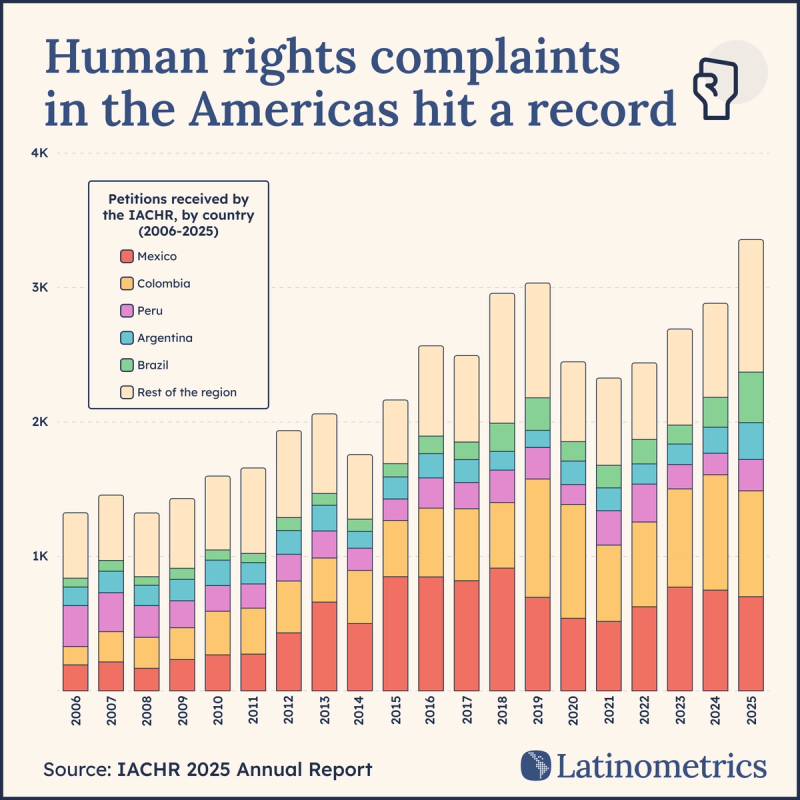
More people are knocking on that door than ever: the IACHR received two and a half times as many petitions in 2025 as it did in 2006.
The filings are also concentrated in a handful of countries. Between 2006 and 2025, Mexico was the target of 10,963 petitions and Colombia of 9,866, or nearly half of everything the Commission received. Add in Argentina, Brazil, and Peru, and those five countries account for over 70% of the total.
Why Costa Ricans Out-File Haitians
It’s tempting to read a rising bar as a sign that a country’s human rights conditions are getting worse. From what we’ve seen studying this pattern, three things decide how many petitions a country’s people send abroad in a given year: whether its own courts can, and are allowed to, handle the case (think of a prosecutor general declining to investigate a sitting president, as Brazil’s did under Bolsonaro), whether the people affected have the money, lawyers, know-how, and allies to take it further, and whether the international body has the power to hear it. A violation only becomes a petition when all three line up. That’s why countries with worse human rights records can have fewer petitions per person than countries with better ones.
Over the past two decades, Costa Ricans have taken their government to the Commission more often than anyone else in Latin America, 228.4 petitions per million inhabitants. Haitians, the least, 6.8 per million. If you know both countries, read that again.
According to the World Bank, Haiti remained the poorest country in the Americas, and among the poorest in the world, in 2025. As allied criminal groups under the “Viv Ansanm” coalition took control of the capital and nearby departments, Human Rights Watch reported “widespread abuses, including massacres, killings, sexual violence, and child recruitment.” That same year, Costa Rica was officially classified as a high-income country by the World Bank, with fairly positive coverage on its Human Rights Watch country page. A full explanation of that gap would take a few doctoral dissertations. The likely short version: Costa Ricans have the money and lawyers to keep going, and Haitians have more urgent things to survive.
Every country has its own mix of reasons. What they all share is the institution they are filing to. So what makes a Costa Rican take their own government to Washington?
The Appeal of the IACHR
Duke Professor Laurence Helfer once argued that three things decide where people take a human rights case: which rights the body protects, how hard it is to get a case in, and what it can do once it rules.
Start with the rights. The Inter-American System covers a lot of ground: the Commission can take up any right written into the OAS declarations and conventions, and the Court works mainly from the American Convention on Human Rights.
Then there’s what the Court can do once it rules. Countries accept it voluntarily, so its rulings bind the country in the case; they also set a precedent everyone else has to reckon with. That’s how, in 2001, a property clause written with individual owners in mind was read to protect the collective land of a Mayagna community in Nicaragua, a ruling Indigenous groups across the region have leaned on since.
Getting in is another matter. The rules are clear. Petitioners must first use up the remedies available at home, with three exceptions: the country’s legal system offers no real way to fix that kind of violation, they were blocked from going to court at all, or the case dragged on for years without a decision.
Clear doesn’t mean easy. Of the 2,771 petitions the Commission evaluated in 2025, 2,040 of them, or 73.6%, were rejected at the first screen: the fight at home wasn’t over, the complaint wasn’t about a right the system protects, or the Commission judged it not serious enough to take up. The bars on the chart keep climbing anyway.
Part of the answer is the design itself, built with exceptions for exactly the situations where home courts fail.
That being said, some rejected petitions may never have been meant to win. When lawyers file to draw attention to an issue nobody is discussing, the prize is the spotlight the Commission brings. The families of the 43 students who disappeared in Ayotzinapa knew Mexico's courts well by the time they went to the Commission in 2014; what they got was a group of independent experts whose reports kept the case on front pages for years. For them, the system's appeal was its legitimacy, and how hard a government finds it to ignore.
Source: IACHR 2025 Annual Report. Per-capita figures computed by Latinometrics.


