
How much does Latin America save to retire?
Chile tops Japan in pension assets per person, yet half its self-funded pensions pay under $180 a month. The 2025 reform wants to change that.


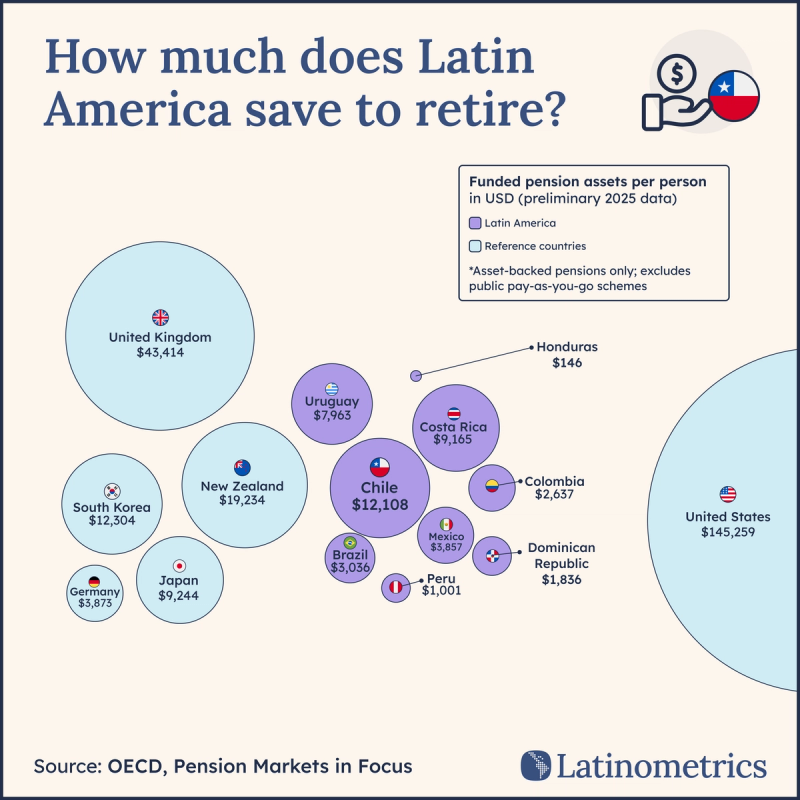
We hope every one of you reading this is either enjoying a comfortable retirement or on track to do so in time. If you are, it will come in one of three ways: a public pension paid by the government out of current taxes, an employer-sponsored plan, or your own savings. Today, we’re looking at OECD data that counts only the second and third, where real assets pile up in an account, so public pay-as-you-go schemes (which in many countries are much more significant for retirement) like US Social Security stay outside the measure.
Chile stands out because, since 1981, the funded buckets have been the core of its entire pension system rather than a supplement. Could that be part of the explanation for the country’s notably large stock market? OECD preliminary pension market data for 2025 suggests that Chile holds more funded pension assets per person than Japan, the world’s fourth largest economy. At the same time, the value of Chile’s listed companies is unusually large relative to the country’s GDP.
That savings pool didn’t appear overnight. For decades, Chile’s pension system relied mainly on its famous, yet controversial, contributory private pension scheme. Under this framework, workers were required to allocate 10% of their taxable income into an individual pension account managed by private pension administrators, or AFPs. While a government-financed safety net also complemented the picture, most recently through the Pensión Garantizada Universal, or PGU, mandatory individual savings accounts formed the core of Chile’s pension system.
Over time, this contributory pillar compounded into a remarkably large pool of pension capital. The OECD preliminary data indicates that AFP-managed assets amounted to $239B by the end of 2025, equivalent to 64% of Chile’s GDP. This also helps explain why Chile surpasses Japan in the chart above: Japan leans on its public two-tier pension system, and its $1.7T Government Pension Investment Fund, by itself larger than Japan’s entire stock of funded pension assets, sits outside the OECD measure. The chart shows Chileans have built an unusually large pool of retirement assets; whether that pool delivers comfortable retirements is a different question.
Where all that money goes
Even though Chile follows a regional trend by holding more pension assets in bonds and cash (56%) than in equities and alternatives (44%), the pool is so large that even that modest slice matters: according to Chile’s Superintendencia de Pensiones, AFPs held $26B in Chilean shares as of January 2026, about 11% of their assets. That sophistication has deep roots: the “Chicago Boys”, Chilean economists trained at the University of Chicago, rebuilt the country’s economy along free-market lines in the 1970s and 80s, while the AFP scheme itself was drawn up by José Piñera, a Harvard-trained minister from the same technocratic wave.
Saving a lot, retiring on little
However, the success of the contributory private pension scheme as a capital-formation mechanism does not mean that it single-handedly explains the depth of the country’s stock market, nor that it has been capable of delivering satisfactory retirement outcomes.
In practice, many Chilean workers pay into their accounts for only about half of their working lives: roughly 27% of workers hold informal jobs, and unemployment, caregiving, and low salaries interrupt the rest. The result: half of the self-funded old-age pensions paid in 2025 came to less than $180 a month, roughly a third of Chile’s minimum wage, according to a Fundación SOL analysis of regulator data. Even a Chilean who works a full career at the average wage can expect a pension worth 61% of their take-home pay, per the OECD, well below what the same worker would get in Argentina (79%), Mexico (80%), or Brazil (98%). These gaps hit women hardest: with lower average earnings, shorter contribution histories, an earlier retirement age, and longer life expectancy, women’s self-funded pensions average 42.6% less than men’s, according to the pension regulator’s latest gender report.
Source: OECD, Pension Markets in Focus (preliminary 2025 data); population from World Bank
The 2025 reform
In March 2025, Chile’s pension reform sought to respond to these shortcomings by adding a new social security system within the contributory pillar. While the reform did not dismantle the individual pension accounts, it required employers to contribute both to workers’ AFP savings and to a new pooled fund, the Fondo Autónomo de Protección Previsional (FAPP). Operating since August 2025, the FAPP is the first social-insurance component inside Chile’s contributory pillar since the AFP model was created in 1981: its money is pooled across workers and pays a bonus per years contributed plus a top-up that equalizes women’s pensions with men’s. Meanwhile, it also gradually raises the maximum PGU from about $240 to $265 a month, phased by age.
It’s not yet clear whether the new system will fully mend the vulnerabilities the old model created, but the rollout is off to a punctual start: employer contributions began arriving with the August 2025 payroll, the new fund had banked some $446M by November, and the first new benefits reached 1.37M pensioners in January 2026. Most of the new money will ultimately land in workers’ individual accounts, deepening the retirement pool that made Chile a regional outlier in the first place.


