
Latin American women out-enroll men by 41%
Their lead dates back to 1993. So why did women still earn 76.7 for every 100 a man took home in 2023?

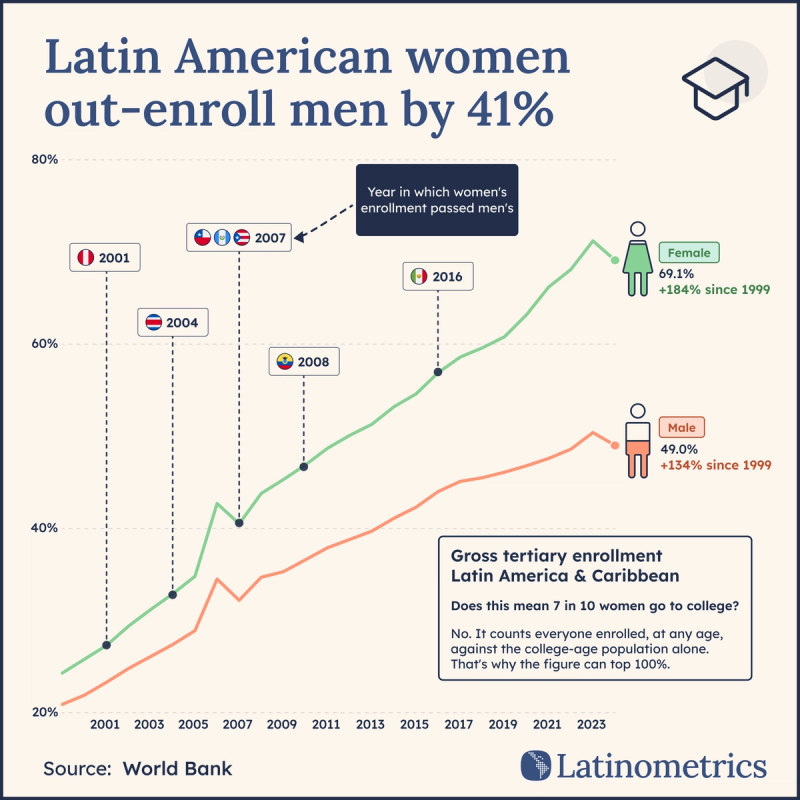
The lead is older than it looks. Latin American women passed men in higher education back in 1993, longer ago than most of the students now filling those lecture halls have been alive.
There is some irony in a male analyst writing that sentence, and more in the fact that he was, by these very numbers, outnumbered in his own graduating class.
Across the world, women’s tertiary enrollment rates have exceeded men’s by an increasingly large margin. The region got there one year after the European Union and eight years ahead of the world as a whole, and the gap between women and men’s gross tertiary enrollment ratio has generally widened ever since. The World Bank measure compares everyone enrolled in higher education, regardless of age, with the population of the age group that would typically attend college or university in a given country.
According to the Inter-American Development Bank (IDB), women’s higher average levels of education have considerably narrowed the persisting gender earnings gap. In fact, based on women’s education levels, they would be expected to earn more than men. As we have previously discussed here at Latinometrics, higher levels of education among women have also been linked to lower levels of violence, more sustainable development, and higher likelihoods of democratic governance.
The gains are real, and they run well past the classroom: less violence, sturdier democracies. The harder question is what they have, and have not, translated into, and why men’s enrollment has climbed so much more slowly.
More education has not produced equality in the labor market
The Economic Commission for Latin America and the Caribbean (ECLAC) underscores in a new report that women’s higher tertiary education enrollment and completion rates have not been sufficient to fully close labor inclusion and earning gaps. Across the region as a whole, women earned an average of 76.7 for every 100 a man took home in 2023.
The Commission argues that one of the main obstacles preventing higher levels of education from translating into higher income parity is segregation in fields of study. In the 17 countries analyzed in ECLAC’s report, the proportion of women graduating in STEM ranged from as little as 5.4% in the Dominican Republic to a maximum of 17% in Trinidad and Tobago. Meanwhile, the proportion of men graduating from these disciplines remained at around 30% in most countries and territories.
Women also cluster in care-related subjects. In most countries in the region, at least 30% of female graduates studied such subjects, reaching at least 50% in countries like Argentina and Brazil. This gender segregation has direct repercussions for job opportunities and earnings, and it does not resolve higher up the ladder either, as we have tracked on corporate boards. Women in the extended care sector continue grappling with substandard employment conditions, lasting income inequalities, and asymmetric participation in contributory pension systems.
Field of study, however, cannot fully explain the disparity. The IDB finds observable characteristics in household surveys, including level of education, generally contribute to reducing the gender earnings gap, while factors that cannot be observed play a crucial role in widening it. These include, for instance, regulations, biases, motherhood penalties, professional development difficulties, and discrimination.
The other side of the gap
Much has also been written about boys and men’s growing underachievement rates. A 2021 World Bank study, for instance, raised multiple explanations related to labor-market influences: immediate pressure to earn, misperceptions about the returns to education, as well as the difficulty of catching up after falling behind academically.
The report also raised questions about how social norms can create certain disadvantages for boys. The construction of “hegemonic masculinity” around ideas of dominance and risk-taking, for example, may play a role in undermining expectations around diligent studying and compliance with school authority. Boys may also receive less academic monitoring at times precisely because adults expect less diligence from them.
The region has spent thirty years closing one gap. It has not yet decided what to do about the one that opened behind it.
Source: World Bank, gross tertiary enrollment ratio (SE.TER.ENRR.FE and .MA). Latest available year per country, 2019–2023. Ratios pass 100% where enrollment includes students older than the standard tertiary age.


