
Latin America's cheapest energy is the energy it saves
Transmission losses cost Latin America $7B a year. Digital power grids and smart modernization can claw it back.


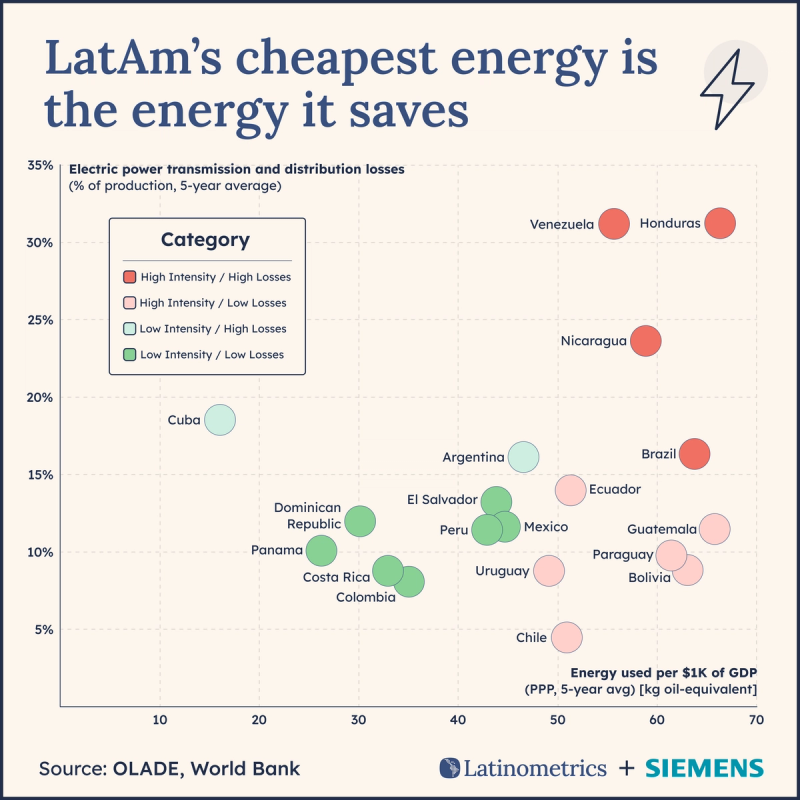
Latin America has long had certain structural energy advantages, including massive hydroelectric dams in the Southern Cone, sprawling solar farms across Mexico, and the world's largest oil reserves off the coast of Venezuela.
Now, merely having more energy independence than regions like Europe or East Asia doesn't mean much if national power grids are outdated and lack adaptability. Today, then, let's evaluate power grids across the region.
To do so, we'll specifically measure energy productivity, which measures how much energy a country uses relative to its GDP, and energy efficiency, which tracks how much energy is lost in transmission or distribution. As you'll see, both vary greatly across Latin America.
Where the power goes missing
On one side, there are countries like Honduras, Nicaragua, and Venezuela, in which underinvestment has led to lower institutional capacity and highly inefficient power grids. These countries see power transmission and distribution losses of 25–30% compared to peers and neighbors which manage to keep losses to just 5-10%. The Venezuelan case is especially egregious—despite being one of the most energy-rich countries worldwide, widespread mismanagement has led to recurring blackouts over the last decade and a half.
Panama, meanwhile, proves the region's grids aren't doomed to inefficiency. Its transmission utility, ETESA, set itself an audacious goal for a country of 4.5 million: build the world's most efficient power grid, with transmission losses below 4%, better than most of Europe.
The country tapped into the power of incentives. Since 1998, Panamanian law has let ETESA keep the extra earnings whenever grid losses drop below 4%. Nobody has to push the utility to fix leaks; every leak it plugs goes straight to its bottom line. Then it employed Latin America's resourcefulness: leaning on multilateral credit and regional suppliers (Mexico's Viakable, Brazil's Forjasul) it restrung existing lines with advanced conductors that cut losses ~30% per line, without touching the expensive towers. No country in the region has cut grid losses faster over the past decade.
Speaking of outliers, we should probably highlight the case of Chile, where transmission losses are lower than anywhere else in the region, yet energy use (relative to GDP) is strikingly high. This seeming paradox is explained by the country's massive and energy-intensive mining industry, which makes up 12% of the national economy and over half of all exports. Put simply: the Chilean energy grid is indeed efficient; it's just dealing with high industry energy demand.
The modernization gap
Across other big Latin American countries like Brazil and Argentina, however, there remains much work to be done to improve transmission efficiency. Grid modernization and digital substations offer strong-ROI solutions for minimizing losses across these countries while being less difficult to implement than macro-level structural economic shifts. After all, regional grid investment has fallen by nearly 40% in recent years, deepening efficiency challenges.
Even in smaller countries with abundant renewable sources, such as Ecuador and Paraguay, energy grids themselves are replacing generation as the primary hurdle to overcome through innovation. In cases like these, digital grid technologies such as AI-enabled monitoring and smart infrastructure can often reduce losses faster than even physical upgrades can—and they're cheaper than ever.
Overall, Latin American electricity grid losses today average 16-17% compared to just 6% in OECD countries, while regional power outages tend to be 10x more frequent than in the European Union. With electricity curtailments and direct losses costing Latin America nearly $7B each year, it's clear there's a real cost to inefficiency—and a real need to make improvements.
As power systems become more complex, technology is emerging as the key enabler of smarter, more efficient grids. From AI-powered monitoring to autonomous grid operations, digital solutions can help Latin America reduce losses, improve reliability, and maximize existing infrastructure.
Source: OLADE (sieLAC), World Bank. Five-year averages, 2019–2023.


