
Opportunity or necessity? Where women work most
Women's labor force peaks in rich and poor countries, driven by opportunity or necessity.

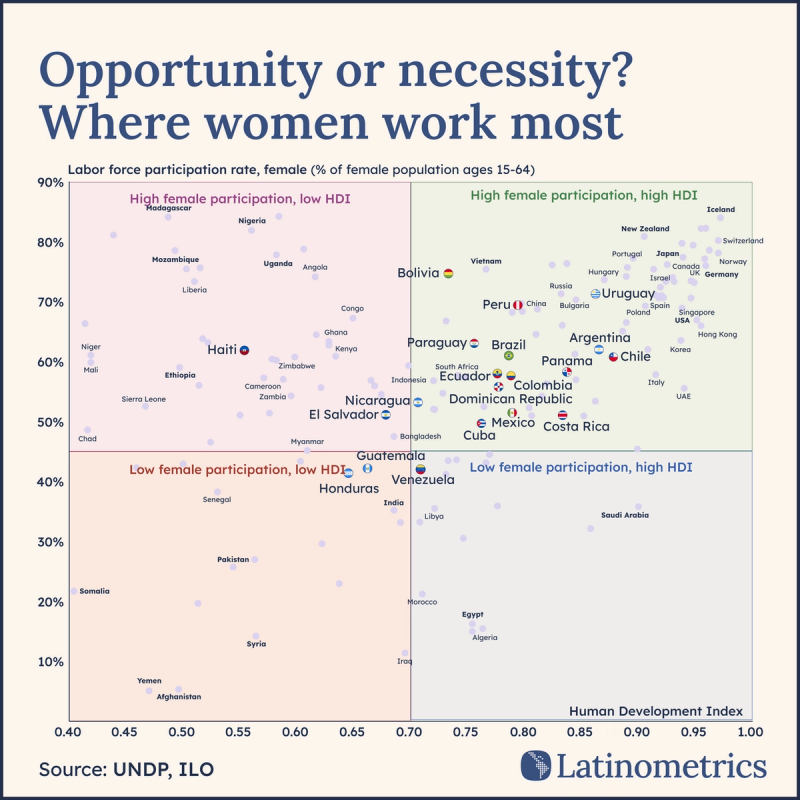
Women’s labor force participation peaks in both the world’s least and most developed countries—driven by different forces.
Twenty years ago, Kofi Annan, then the Secretary-General of the United Nations, said that “There is no tool for development more effective than the empowerment of women.”
To Annan, most major developmental issues requiring global attention – from economic productivity, infant and maternal mortality, and nutrition to HIV prevention and education – would be best served by empowering women and improving their qualities of life.
And without any doubt, many of the world’s most developed countries tend to have women integrated in their labor forces. Europe, for example, contains global leaders like Iceland, Sweden, and Switzerland. On the flip side, least developed countries (LDCs) like Afghanistan, Somalia, and Yemen are all among the countries with the lowest participation by women in the workforce.
But the global pattern is more nuanced than a simple upward curve.
In fact, female labor force participation tends to peak at both ends of the development spectrum. In wealthy countries, women often work due to greater educational and economic opportunity. In some of the poorest countries, by contrast, women work out of necessity—often in informal or subsistence roles—because households cannot survive on a single income.
This dichotomy is somewhat visible within Latin America as well. Southern Cone countries like Argentina, Chile, and Uruguay are regional leaders in female participation, reflecting their relatively high levels of development. By contrast, less than 45% of females work in Honduras, Guatemala, and Venezuela.
But even among regional leaders, there are schisms among more liberal or conservative countries. Costa Rica, for example, is relatively developed for a country where only half of women are working—with this low rate perhaps best explained by relatively high degrees of evangelicalism.
But overall, the data certainly seems to lend credence to Annan’s thoughts on women’s empowerment. The region will clearly be limited in its growth and development if over half its population is being held back.
So what can the region do to ensure greater female participation in the workforce—not just by necessity, but by choice?


